
What Does an MDR Consultant Do, and When Do You Need One? Selection Criteria
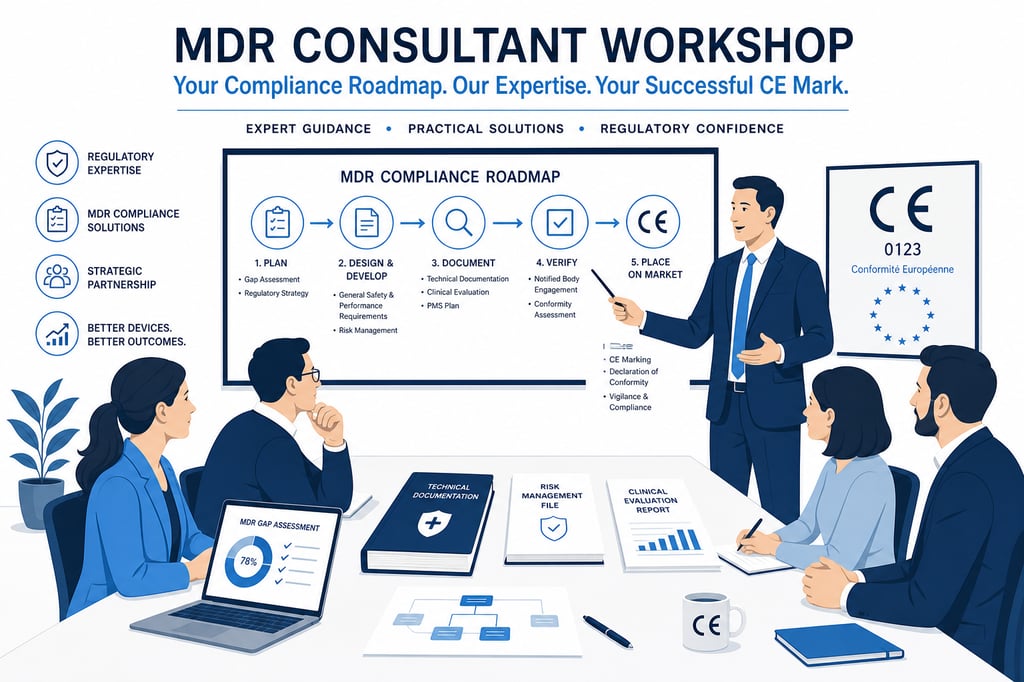
Short answer: An MDR consultant plans and runs a medical device manufacturer's route to compliance with Regulation (EU) 2017/745: gap analysis, classification, quality management system implementation, the GSPR and risk file, clinical evaluation (CER) and PMCF, technical documentation, notified body selection and correspondence, and deficiency responses. The consultant does not take on the manufacturer's legal responsibility — the manufacturer owns and signs the technical documentation. A consultant adds the most value for teams doing the MDR process for the first time, with limited in-house RA/QA capacity, or working to a tight timeline.
Key takeaways
- A consultant does: planning, file preparation, training, audit readiness, notified body management, deficiency/crisis resolution.
- A consultant does not: take on legal responsibility, sign the declaration of conformity, or act as the PRRC (except for micro/small enterprises and authorised representatives).
- When you need one: first MDR project, an up-classification, an MDD transition, uncertainty over clinical data strategy, an NB deficiency crisis, a need for fast output rather than fast hiring.
- When you may not: you have a mature RA/QA team, an up-to-date MDD file and a comfortable timeline — targeted support for specific work packages may be enough.
This article is part of the What is the EU MDR? pillar guide.
What exactly does an MDR consultant do?
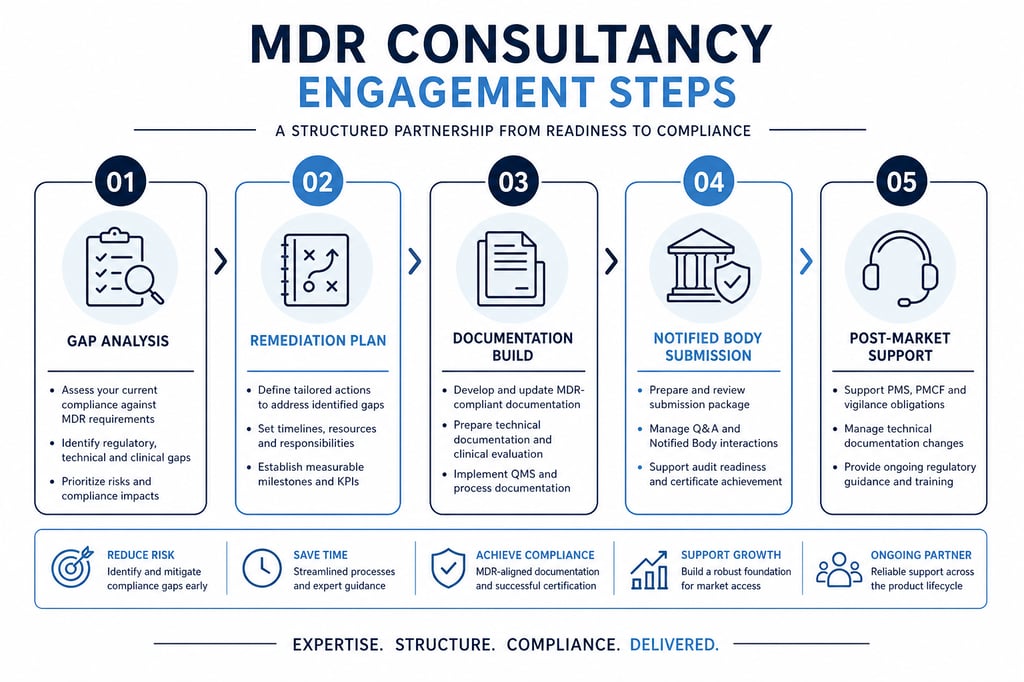
A typical service scope:
| Phase | The consultant's work |
|---|---|
| Diagnosis | Gap analysis (Annexes I/II/III), classification file, roadmap and budget model |
| Quality system | Implementing/updating ISO 13485 + MDR procedures, internal auditor training |
| Technical file | GSPR checklist, risk management file (ISO 14971), verification/validation plan, IFU/label |
| Clinical | Clinical evaluation plan and CER, equivalence assessment, PMCF plan, clinical investigation design support if needed |
| Notified body | NB selection and scope check, application file, mock audit, deficiency responses |
| Market access | UDI structure, EUDAMED/ÜTS registration, authorised representative setup, draft declaration of conformity |
| Maintenance | PSUR/PMCF cycle, significant-change assessment, recertification readiness |
A good consultant also transfers knowledge: teaching the procedures and the reasoning so your team can sustain the process on its own.
When do you need a consultant?
- Your first MDR/CE project. The learning curve is steep; an experienced external eye reduces deficiency cycles and rework.
- Your device was up-classified under the MDR. A new conformity route, clinical data and NB scope are needed. Check the class change: medical device classification (cluster link).
- An MDD transition with deadline pressure. For devices in the 2027 group, time is critical: the MDR transition period (cluster link).
- The clinical strategy is unclear. Is equivalence defensible, or is a clinical investigation required — this decision drives budget and timeline.
- A notified body deficiency crisis. You need fast, correct answers with the response window closing.
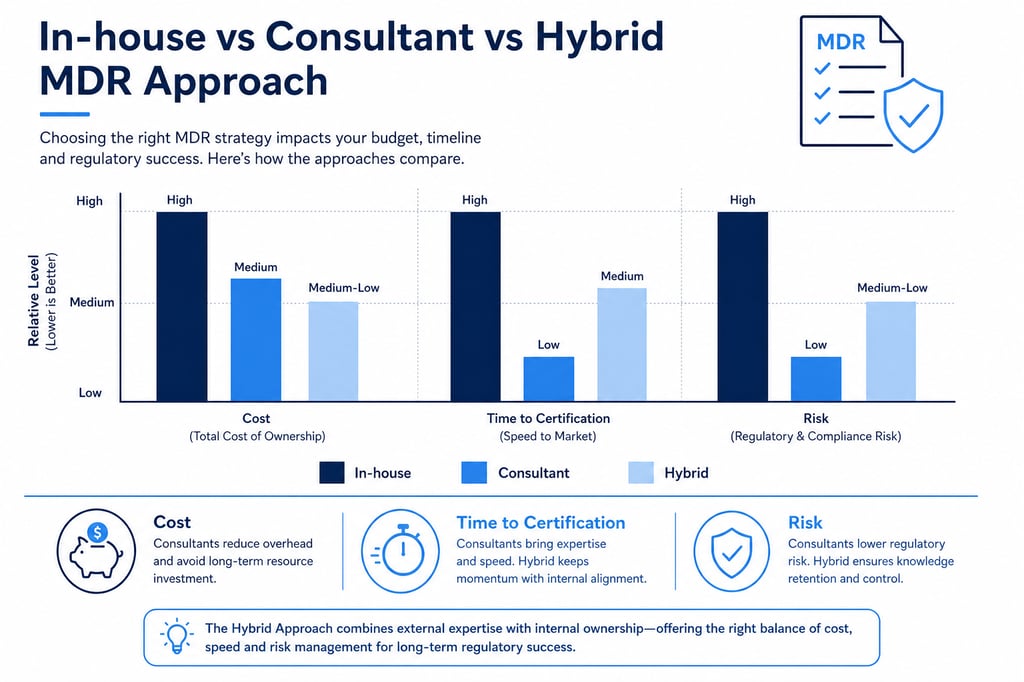
- An in-house capacity bottleneck. Your RA/QA team is full with the current portfolio; you want fast output rather than fast hiring.
When you may not need a consultant
- You have an experienced RA/QA team with MDR-certified products.
- You have an up-to-date, well-structured MDD/technical file and a comfortable timeline.
- You only need a specific expertise (e.g. only the biocompatibility evaluation or only the CER) — a point work package rather than the whole process may be enough.
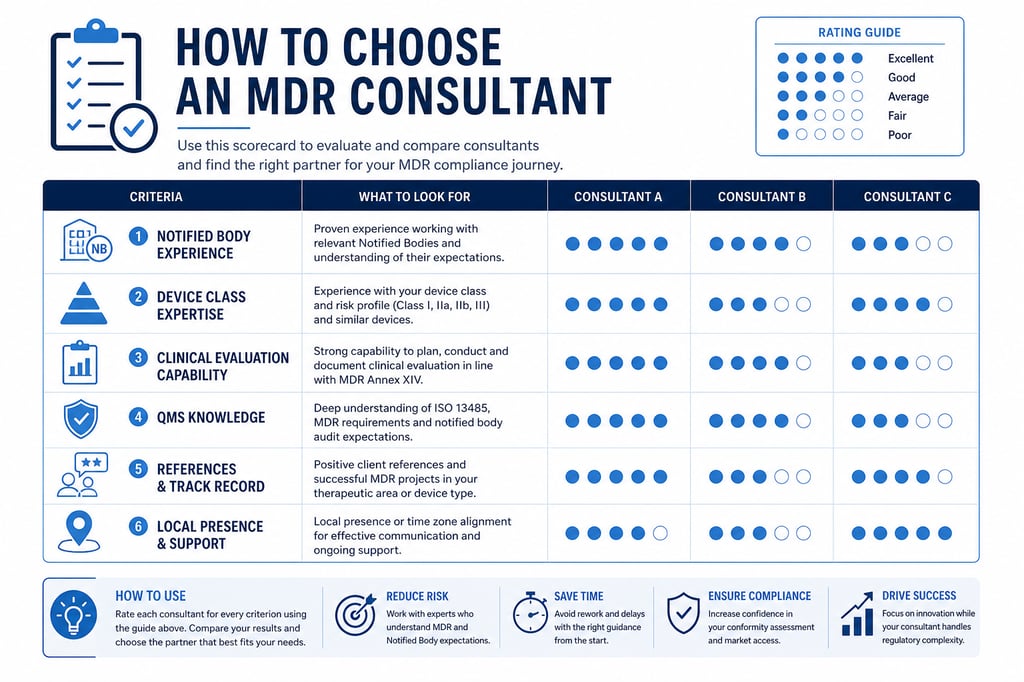
How to choose the right consultant
- Notified body / audit experience. A consultant who can see the file through an auditor's eyes raises the chance of first-time approval.
- References matching your device type. Implant, software, IVD, active device — experience is domain-specific. Ask for an anonymised case study.
- Delivery in your languages. Technical file and NB correspondence in English; local team communication in Turkish.
- Transparent scope and price. Work packages, deliverables, revision limits and pricing in writing. Be wary of vague "turnkey" promises.
- No conflict of interest. The consultant should not take commission for steering you to a particular notified body or test lab; recommendations should be reasoned.
- A knowledge-transfer commitment. A good consultant does not make you dependent; it builds your team's capability.
- Realism. Choose the consultant who gives an accurate, not optimistic, estimate of time and cost: MDR compliance cost and timeline (cluster link).
Red flags
- "We guarantee the certificate" — no consultant can guarantee an NB decision.
- A fixed, device-independent single price — a price quoted before the scope is understood invites surprises.
- Delivering a template technical file with the name changed — the NB will notice.
- Reluctance to provide references.
- Saying the consultant will sign the declaration of conformity — that is the manufacturer's obligation.
The typical engagement model
- Initial assessment (usually free, 30–60 min): device, class, current state, target market and timeline.
- Gap analysis and proposal: scope, work packages, deliverables, duration, price.
- Execution: weekly/biweekly check-ins, a shared file structure, regular status reporting.
- Audit readiness: internal audit, mock audit, open-items list.
- NB process: application, audit, deficiency responses, certificate.
- Handover: procedures, training, maintenance schedule.
Frequently asked questions
Does the consultant "own" the technical file? No. The manufacturer owns and is responsible for the file; the consultant prepares and supports.
Can the consultant be the PRRC? An outsourced PRRC is possible only for authorised representatives and micro/small manufacturers: who is the PRRC? (cluster link).
Does consulting pay for itself? For teams doing the MDR process for the first time, usually yes; deficiencies and rework fall. The outcome depends on the device and the team.
Remote or on-site? Most work runs remotely; on-site days are planned for the mock audit and some workshops.
How should the contract be structured? Work-package based, with clear deliverables and acceptance criteria; open-ended hourly models increase budget risk.
The MEGACERT approach
Our team includes specialists with notified body audit experience, and we have supported the certification of more than 500 devices. We work in Turkish and English, give scope and price in writing, avoid conflicts of interest, and transfer knowledge to your team on every project. Let us start with a free initial assessment for your device. → Contact / book a call
Sources
- Regulation (EU) 2017/745, Articles 10, 15, 52. EUR-Lex.
- MDCG 2019-7 — PRRC guidance (outsourcing conditions).
- MDCG 2022-14 — MDR capacity and access; context on consulting and the NB bottleneck.
- Team-NB — Best Practice Guidance for technical documentation submission (expectations for a consultant-prepared file).
Last updated: 30 August 2026. General information only; every project must be assessed on its own circumstances.