
The MDR Transition Period and Deadlines: The 2027–2028 Extensions (Regulation 2023/607)
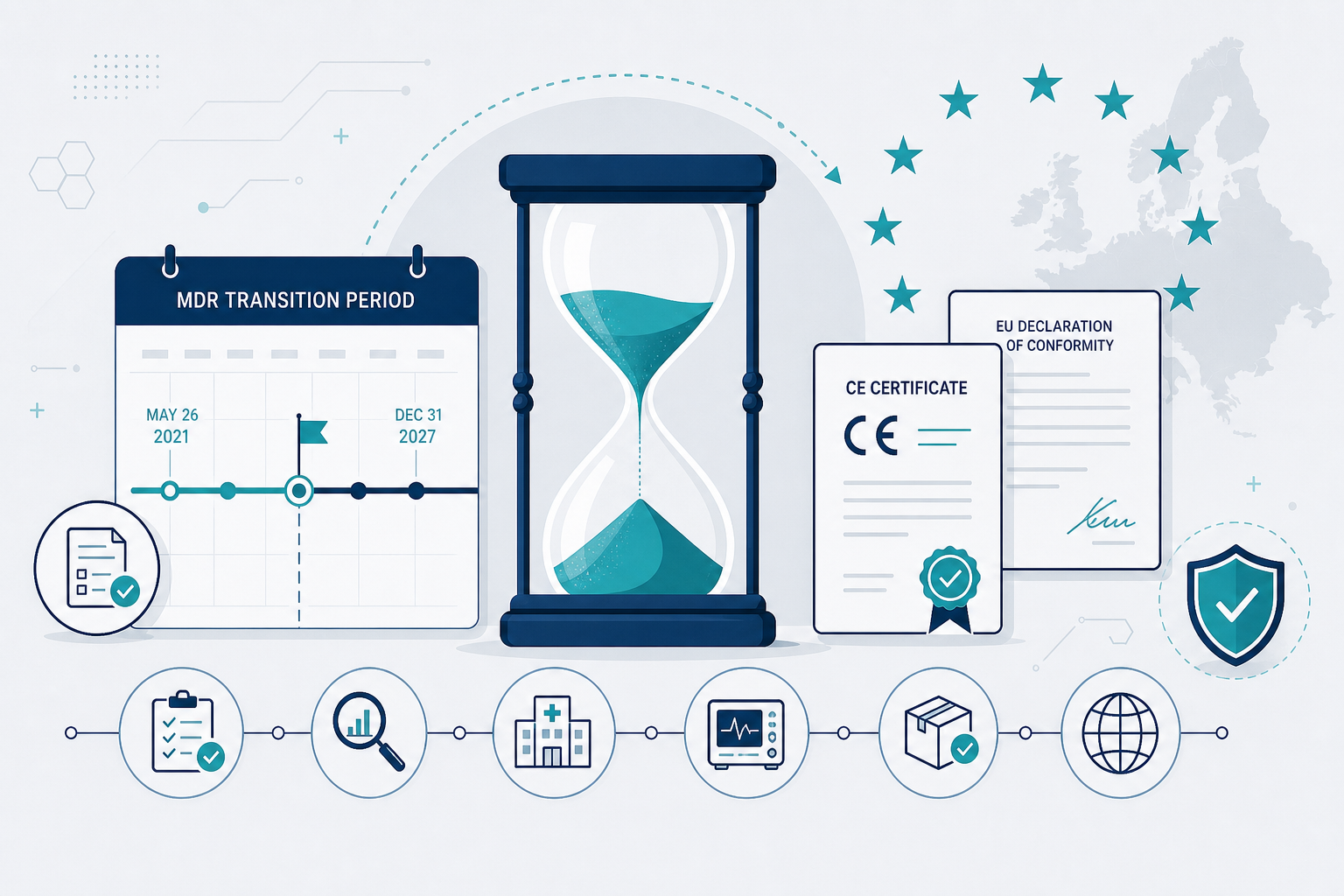
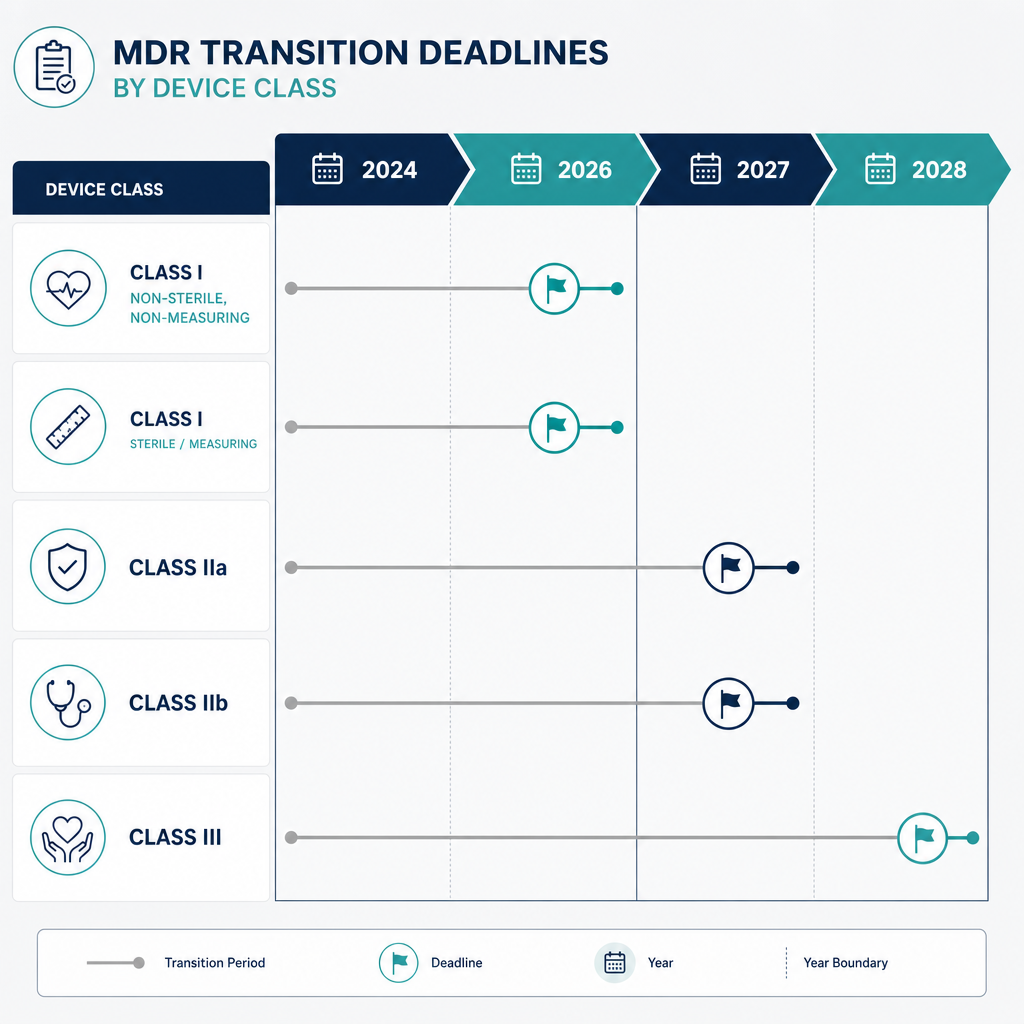
Short answer: The EU MDR (Regulation (EU) 2017/745) became applicable on 26 May 2021. For devices certified under the MDD/AIMDD, Regulation (EU) 2023/607 extended the transition periods and removed the "sell-off" date. Where the conditions are met, existing certificates are recognised until 31 December 2027 for Class III and implantable Class IIb devices, and 31 December 2028 for other Class IIb, Class IIa, and sterile/measuring Class I devices. This is not a delay — it is a conditional bridge, and the obligations apply now.
Verification note: dates and conditions change over time. Before critical decisions, confirm against EUR-Lex 2023/607 and the European Commission, and verify in writing with your notified body.
Key takeaways
- Two critical dates: 31 December 2027 (high risk) and 31 December 2028 (medium/low risk).
- The extension is not automatic. It requires an MDR-compliant QMS, a timely notified body application, and a signed written agreement.
- The "sell-off" date is removed — devices under the transitional regime can remain in the supply chain after the deadline.
- No significant changes: during transition, you cannot make significant changes to the device design or intended purpose.
- Class III custom-made implantable devices: separate deadline — 26 May 2026.
- The IVDR follows a different timeline (see the IVDR guide).
This article is part of the What is the EU MDR? pillar and complements MDR vs MDD.
Timeline
| Date | Event |
|---|---|
| 26 May 2021 | MDR became applicable; MDD and AIMDD repealed |
| 20 March 2023 | Regulation (EU) 2023/607 published: transition periods extended, sell-off date removed |
| 26 May 2024 | Condition: MDR-compliant QMS in place and a formal application lodged with a notified body |
| 26 September 2024 | Condition: a written agreement signed between manufacturer and notified body |
| 26 May 2026 | Deadline for Class III custom-made implantable devices |
| 31 December 2027 | Conditional deadline for Class III and implantable Class IIb devices (with certain exceptions) |
| 31 December 2028 | Conditional deadline for other Class IIb, Class IIa, and sterile/measuring Class I devices |
What is a "legacy device"?
In MDCG 2021-25 terminology:
- Legacy device: a device placed on the market after the MDR date of application under the transitional provisions, on the basis of a valid MDD/AIMDD certificate or (for Class I) a declaration of conformity.
- "Old" device: a device already placed on the market before 26 May 2021.
- MDR device: a device certified under the MDR.
For legacy devices, the MDR provisions on post-market surveillance, market surveillance, vigilance, economic operators and registration apply during the transition; but conformity assessment, surveillance and technical documentation continue under the old directive rules.
Conditions for the extension
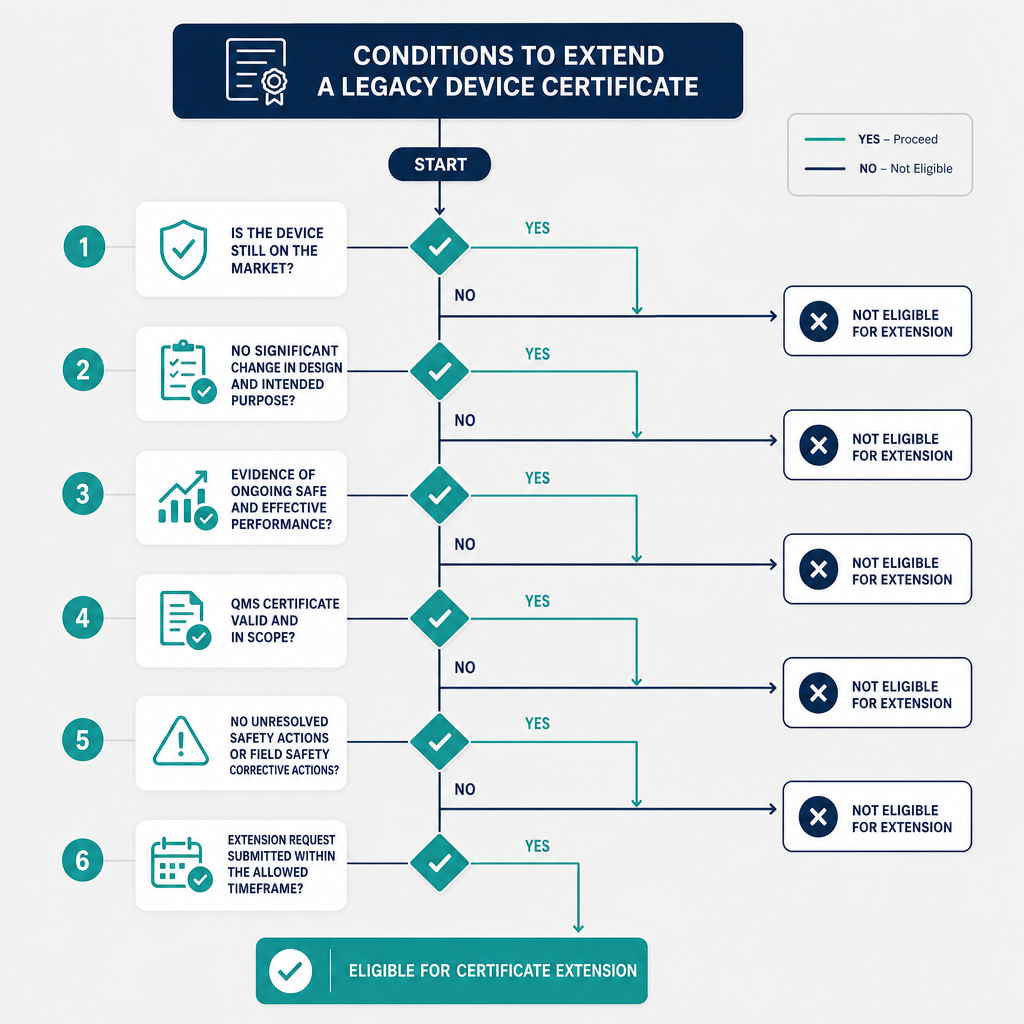
To earn transition rights until the 2027/2028 deadlines, all of the following must hold:
- The device was lawfully placed on the market under the MDD/AIMDD before 26 May 2021.
- There is no significant change in design or intended purpose.
- The device presents no unacceptable risk to health or safety.
- By 26 May 2024, the manufacturer has an MDR-compliant quality management system (ISO 13485 + MDR requirements).
- By 26 May 2024, the manufacturer or authorised representative has lodged a formal application with a notified body for MDR conformity assessment.
- By 26 September 2024, a written agreement is signed between the notified body and the manufacturer.
Devices that do not meet these conditions have their MDD certificate treated as lapsed without waiting for the deadline.
Deadlines by class and exceptions
| Device group | Conditional deadline |
|---|---|
| Class III implantable custom-made devices | 26 May 2026 |
| Class III devices | 31 December 2027 |
| Class IIb implantable devices (except the list below) | 31 December 2027 |
| Exception: sutures, staples, dental fillings, dental braces, tooth crowns, screws, wedges, plates, wires, pins, clips, connectors | 31 December 2028 |
| Other Class IIb devices | 31 December 2028 |
| Class IIa devices | 31 December 2028 |
| Class I sterile (Is), measuring (Im) or reusable surgical instruments (Ir) with an MDD NB certificate | 31 December 2028 |
Note: for devices that were Class I under the MDD but are up-classified under the MDR (e.g. some software), transition rights are limited if there was no MDD notified body certificate; those devices need a separate assessment. Check for a class change: medical device classification (cluster link).
What is a "significant change" and why it matters
If, during the transition, you make a significant change to the device design or intended purpose, the device loses its transition rights and must be certified directly under the MDR. Use the MDCG 2020-3 decision trees; changes to software, materials, design, sterilisation method and intended purpose are each assessed separately. Safety-driven changes from corrective action (CAPA) are generally not "significant."
EUDAMED and registration obligations
The MDR registration and traceability provisions apply to legacy devices too: economic operator registration, device registration (Basic UDI-DI / UDI-DI) and — in Türkiye — ÜTS registration. EUDAMED modules are becoming mandatory in stages; confirm the current mandatory timeline with the European Commission.
Do not confuse it with the IVDR
In vitro diagnostic devices are covered by the IVDR (Regulation (EU) 2017/746) and follow a different transition timeline (with later amendments setting staggered deadlines for Class D, C, B and sterile Class A). The MDR transition rules do not apply to IVDs. See our IVDR guide.
What should you do now, as a manufacturer?
- Classify your portfolio and prioritise by deadline. Devices in the 2027 group are urgent.
- File the evidence for the conditions: QMS implementation date, NB application correspondence, signed agreement.
- Run a gap analysis (MDR Annexes I, II, III) and set the clinical data strategy.
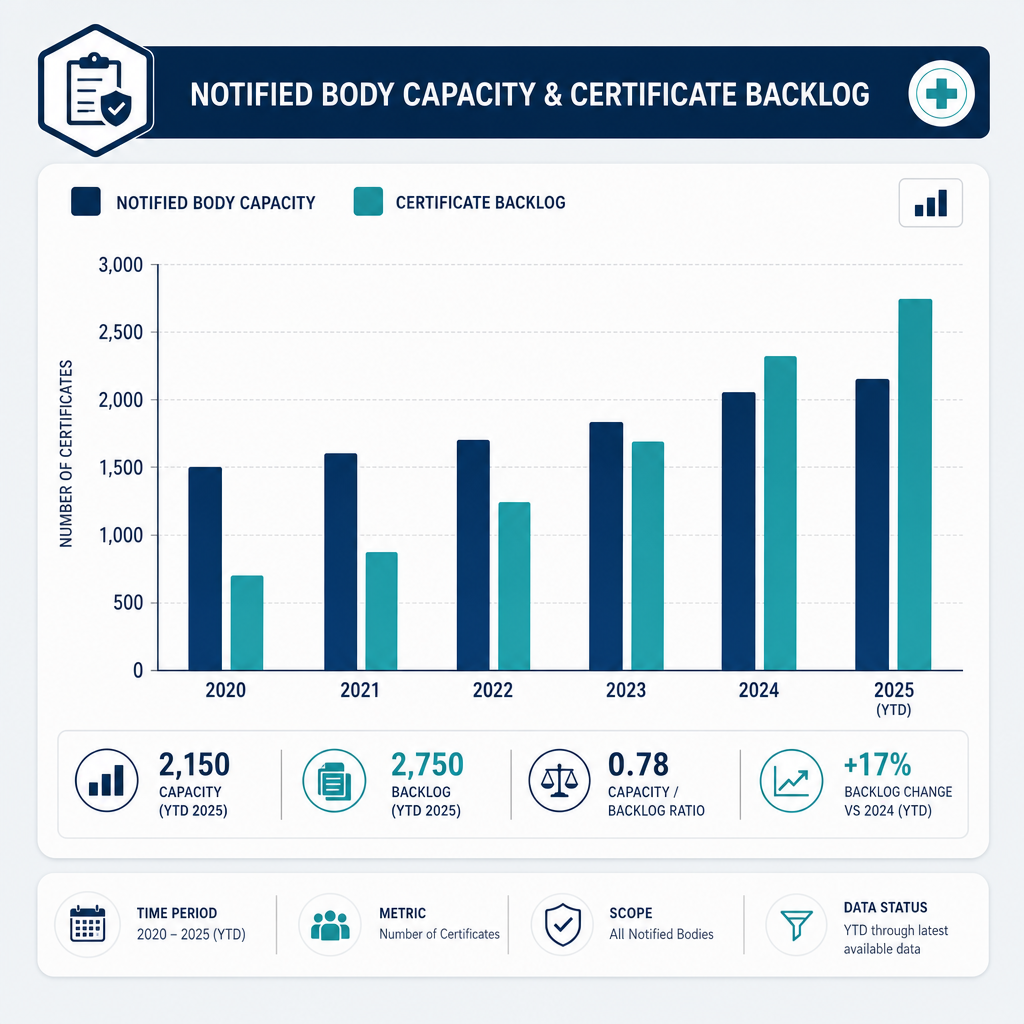
- Project the notified body timeline; leave a buffer for deficiency cycles.
- Rationalise the product range: decide whether low-volume / high-cost SKUs are worth maintaining.
- Inform the supply chain: communicate deadlines and stock plans to distributors and hospitals.
Process steps: The MDR compliance process: 8 steps to CE marking. Budget and timeline: MDR compliance cost and timeline (cluster links).
Frequently asked questions
Is the extension automatic? No. If the conditions are not met, your MDD certificate lapses.
Can I sell my device after the deadline? If it is under the transitional regime and you obtained an MDR certificate by the deadline, yes. If not, you cannot place it on the market after that date — though, because "sell-off" was removed, devices already placed on the market before the date can remain in the supply chain.
I applied to a notified body but the audit is delayed — do I lose my rights? If the conditions (application and agreement dates) were met, a late audit does not end the transition rights by itself; you still need the MDR certificate before the deadline.
Do these dates apply to my MDD Class I device? Simple Class I devices with no NB certificate were expected to be MDR-compliant from 26 May 2021; only up-classified devices or NB-certified Is/Im/Ir devices use the 2028 bridge.
Is the timeline different in Türkiye? The Turkish Medical Device Regulation is aligned with the EU; the TİTCK generally follows the EU dates. Track current TİTCK announcements.
How MEGACERT helps
We manage portfolio prioritisation, the conditions evidence file, gap analysis and notified body correspondence. Let us map which of your devices sits on which deadline in a free 30-minute call. → Contact
Sources
- Regulation (EU) 2023/607 — amending the transitional provisions. EUR-Lex. https://eur-lex.europa.eu/eli/reg/2023/607/oj
- Regulation (EU) 2017/745, Article 120 (transitional provisions). EUR-Lex.
- MDCG 2021-25 — Application of MDR requirements to legacy devices and to devices placed on the market prior to 26 May 2021.
- MDCG 2020-3 rev.1 — Significant changes under the transitional provision.
- MDCG 2022-18 — MDR Article 97 and continued market availability. European Commission.
- European Commission. Medical devices — New regulations. https://health.ec.europa.eu/medical-devices-sector/new-regulations_en
Last updated: 30 August 2026. General information only; dates and conditions must be verified against official sources.