What Is the EU MDR (Regulation 2017/745)? A Complete Guide for Manufacturers
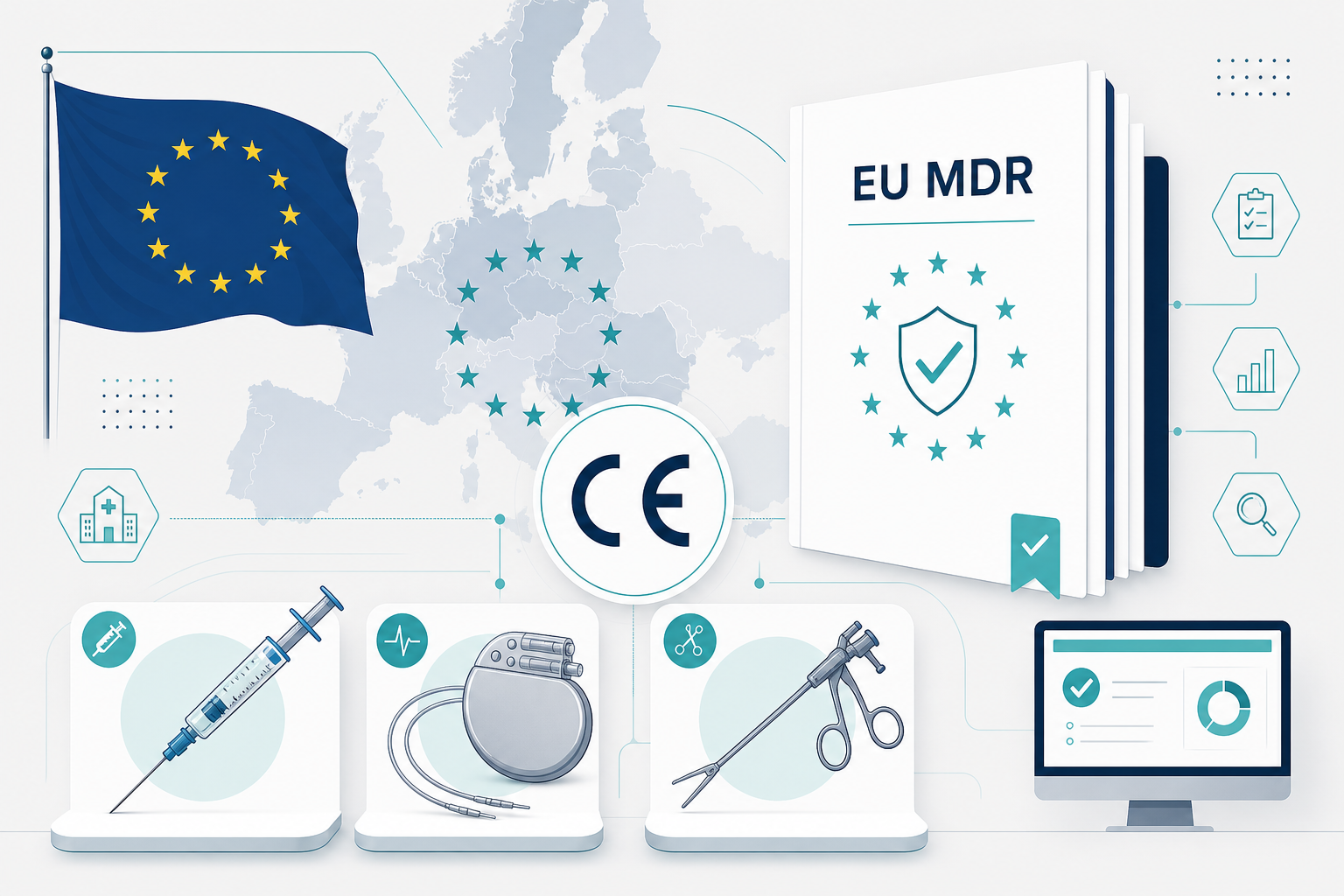
Short answer: The EU MDR — formally Regulation (EU) 2017/745 on medical devices — is the legal framework that governs how medical devices are placed on the market, made available, and monitored in the European Union. It was published on 5 May 2017, became applicable on 26 May 2021, and replaced the earlier Medical Devices Directive (93/42/EEC, MDD) and Active Implantable Medical Devices Directive (90/385/EEC, AIMDD). Any manufacturer selling a medical device into the EU must comply, regardless of where the company is located. Manufacturers based outside the EU — including in Türkiye — must also appoint an EU Authorised Representative.
Key takeaways
- What it is: Regulation (EU) 2017/745 — a single, directly binding regulation for medical devices across the EU (stricter than a directive, with no national transposition).
- Who it affects: Manufacturers, authorised representatives, importers and distributors (the four "economic operators"), plus notified bodies.
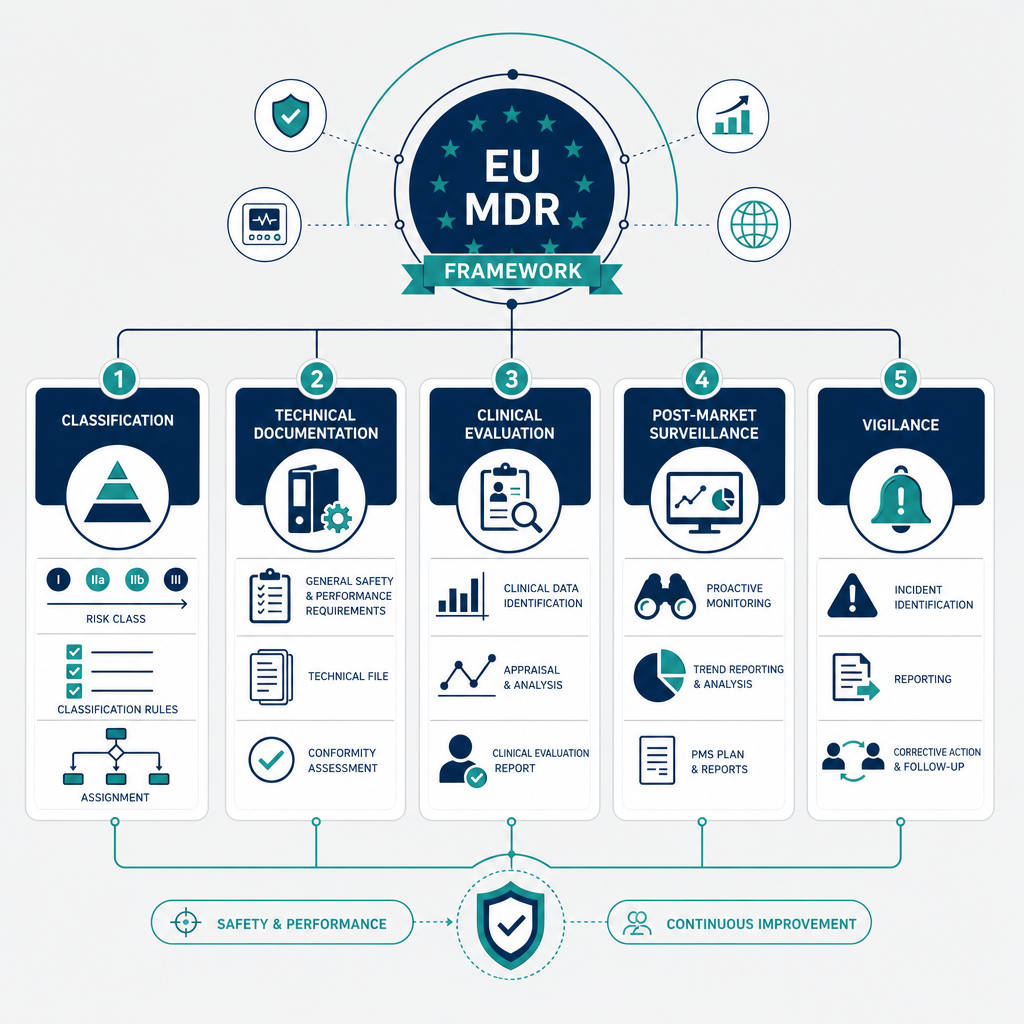
- Core obligations: an ISO 13485-based quality management system, conformity with the General Safety and Performance Requirements (Annex I), Annex II–III technical documentation, clinical evaluation, post-market surveillance (PMS), UDI and EUDAMED registration, and a designated PRRC.
- Classification: Classes I, IIa, IIb and III, determined by the 22 rules in Annex VIII; obligations rise with risk.
- Transition timeline: under Regulation (EU) 2023/607, valid MDD/AIMDD certificates are recognised — conditionally — until 31 December 2027 (Class III and implantable Class IIb) or 31 December 2028 (other Class IIb, Class IIa, sterile/measuring Class I).
- For Türkiye-based manufacturers: Türkiye's Medical Device Regulation mirrors the EU MDR; the competent authority is the TİTCK. To sell in the EU you still need an EU Authorised Representative and an EU notified body.
What does "MDR" mean? A note on the acronym
A search for "MDR" returns three unrelated topics:
- Medical Device Regulation — the subject of this guide; EU medical device law.
- Managed Detection and Response — a cybersecurity service.
- Sony MDR — a headphone product line; also Mitteldeutscher Rundfunk, a German broadcaster.
Throughout this guide, "MDR" means Regulation (EU) 2017/745. You will also see a related acronym: IVDR, Regulation (EU) 2017/746 on in vitro diagnostic medical devices. The IVDR is separate legislation, applicable since 26 May 2022, and covers laboratory diagnostic tests, assays and reagents.
Why the MDR exists and what changed
The MDR was drafted after the safety scandals of the early 2010s — notably the PIP breast implants and metal-on-metal hip replacements — to strengthen patient safety and oversight. Compared with the directive regime, the main changes are:
- Wider scope. Certain products without a medical purpose (Annex XVI: coloured contact lenses, dermal fillers, liposuction equipment, some high-intensity light sources) are now covered.
- Stronger clinical evidence. Relying on "equivalence" instead of your own clinical data has become very difficult, especially for Class III and implantable devices.
- Reclassification. Many devices moved up a class — for example software under Rule 11, spinal implants, and devices incorporating nanomaterials.
- Systematic post-market surveillance. A PMS plan, PSUR (periodic safety update report) and PMCF (post-market clinical follow-up) are now mandatory and continuous.
- Traceability. Each device carries a UDI (unique device identifier); operators, devices and certificates are registered in EUDAMED.
- Corporate accountability. Every manufacturer and authorised representative must designate a qualified PRRC (Person Responsible for Regulatory Compliance).
- Tighter notified body oversight. Notified bodies were re-designated under the MDR; unannounced audits and sample testing increased.
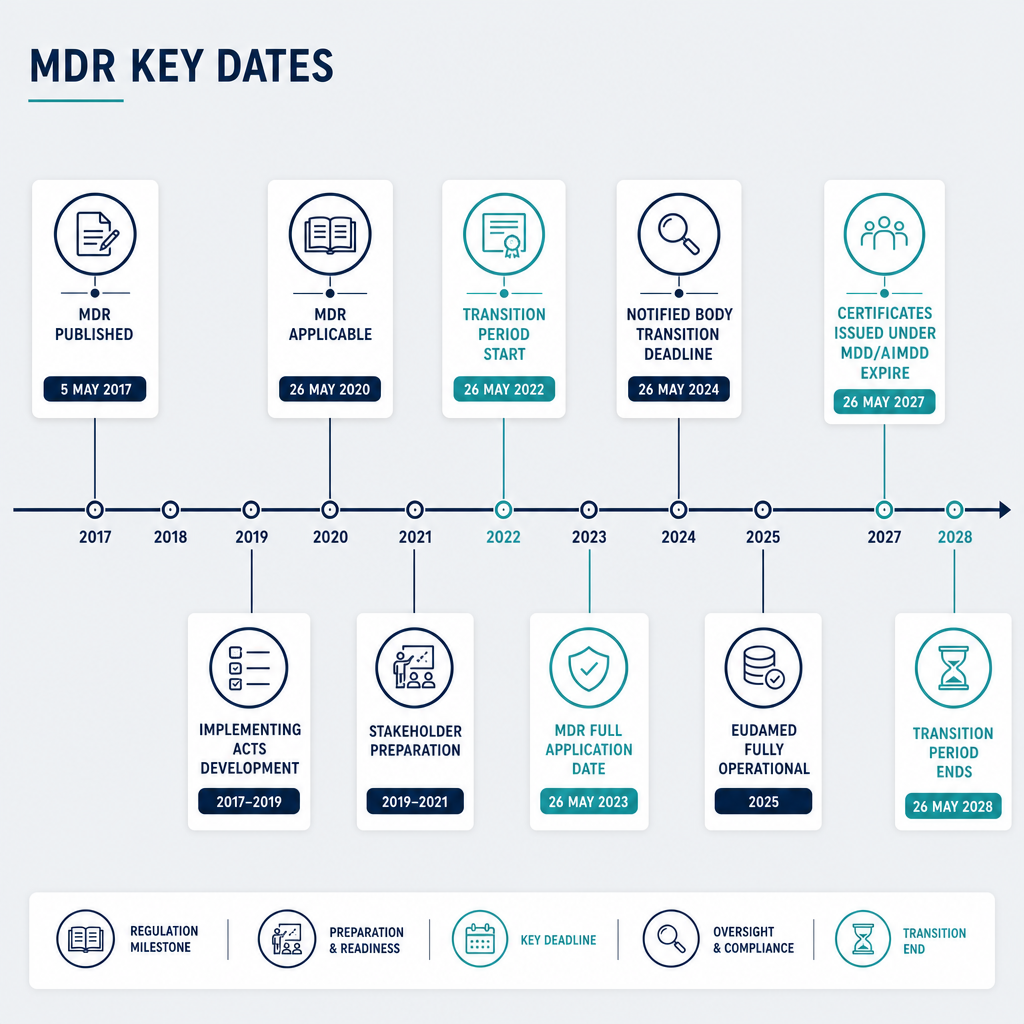
MDR entry into force and application dates
| Date | Event |
|---|---|
| 5 May 2017 | Regulation (EU) 2017/745 published in the Official Journal |
| 25 May 2017 | Entered into force |
| 26 May 2020 | Original date of application |
| 24 April 2020 | Regulation (EU) 2020/561 postpones application by one year (COVID-19) |
| 26 May 2021 | MDR became applicable; MDD and AIMDD repealed |
| 20 March 2023 | Regulation (EU) 2023/607 extends the transition periods and removes the "sell-off" date |
| 31 December 2027 / 2028 | Conditional transition deadlines for MDD/AIMDD certificates (see below) |
Verification note: MDR and IVDR dates, and the EUDAMED mandatory-use timeline, change over time. Before making critical decisions, confirm dates against EUR-Lex and the European Commission's medical devices pages.

What the MDR means for manufacturers based in Türkiye
Under the EU–Türkiye Customs Union, Türkiye keeps its medical device law aligned with the EU. The Turkish Medical Device Regulation (Tıbbi Cihaz Yönetmeliği) entered into force on 2 June 2021 and largely mirrors Regulation (EU) 2017/745, with a separate regulation for in vitro diagnostics. The competent authority is the Turkish Medicines and Medical Devices Agency (TİTCK).
Practical points for Turkish manufacturers selling into the EU:
- You must appoint an EU Authorised Representative (EC REP) established in an EU member state.
- Registration in Türkiye's ÜTS (Product Tracking System) and registration in the EU's EUDAMED are separate obligations.
- A CE certificate from a Türkiye-based notified body (for example TSE, UDEM or Szutest) is valid in the EU provided that body is designated under the MDR.
- Your technical documentation must be in a language accepted by your notified body and your authorised representative — in practice, English.
Who the MDR applies to: economic operators
| Operator | Definition | Headline obligation |
|---|---|---|
| Manufacturer | Places the device on the market under its own name | Technical documentation, declaration of conformity, CE marking, PMS, PRRC |
| Authorised representative (EC REP) | The EU legal contact for a non-EU manufacturer | Keeps the technical documentation available, liaises with authorities, PRRC |
| Importer | Places a device from a third country on the EU market | Verifies conformity, registers, controls storage, handles complaints |
| Distributor | Any other party making a device available in the supply chain | Checks label/IFU and CE mark, ensures traceability, reports non-conformity |
A full breakdown is in Economic operators under the MDR: manufacturer, importer, distributor and authorised representative obligations (cluster link).
Device classification (MDR Annex VIII)
Every device falls into one of four classes based on intended purpose and risk:
- Class I — low risk (e.g. examination gloves, wheelchairs). Sub-categories: Is (sterile), Im (measuring function), Ir (reusable surgical instruments).
- Class IIa — low–medium risk (e.g. most dental materials, hearing aids).
- Class IIb — medium–high risk (e.g. ventilators, insulin pens).
- Class III — high risk (e.g. heart valves, hip implants, absorbable sutures).
The class is set by applying the 22 rules in Annex VIII, which turn on invasiveness, duration of contact, whether the device is active, and interaction with the circulatory or central nervous system. Every device above Class I requires a notified body in the conformity assessment.
Rule-by-rule explanation and examples: Medical device classification: Classes I, IIa, IIb and III (MDR Annex VIII, 22 rules) (cluster link). Software is a special case — see Is your software a medical device? MDR Rule 11 and MDCG guidance.
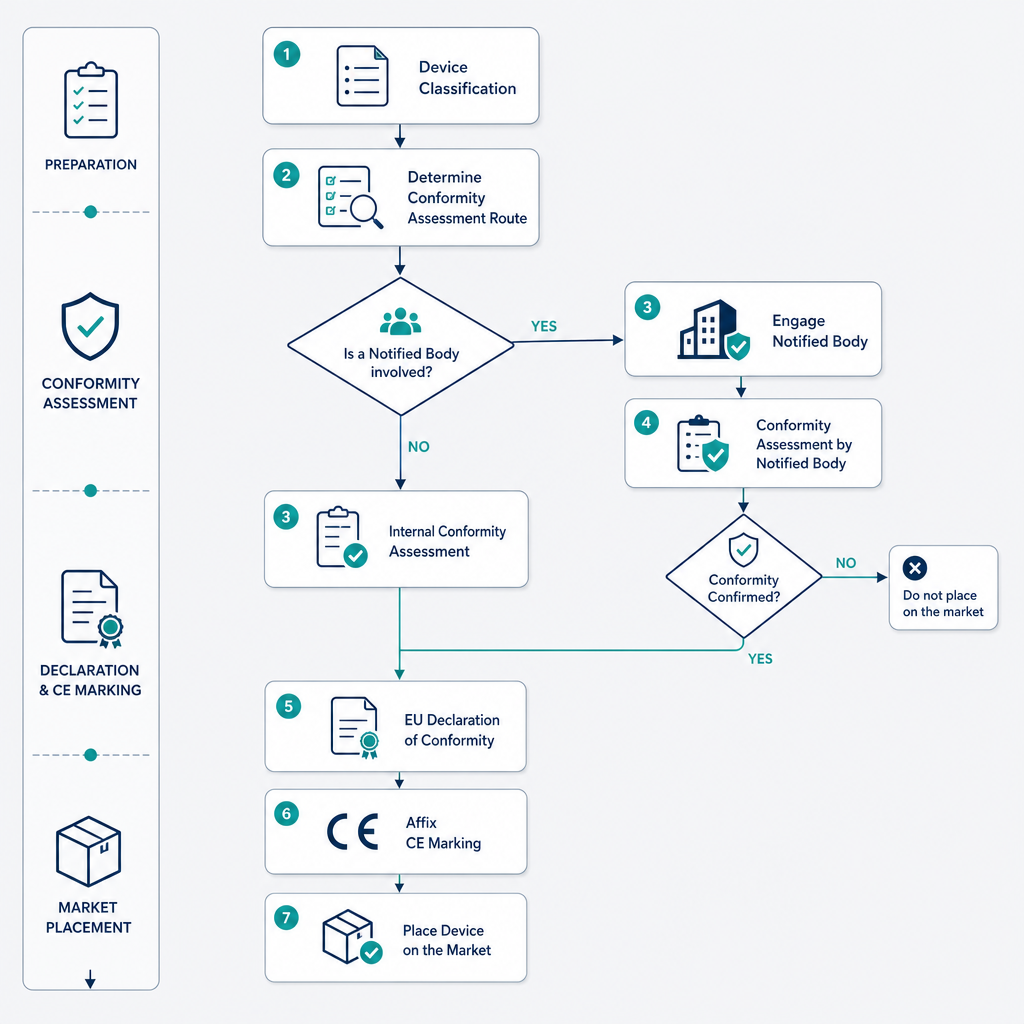
The steps to CE marking under the MDR
- Define the device — intended purpose, user, claimed clinical benefit.
- Classify it — Annex VIII rules.
- Implement a quality management system — usually based on ISO 13485:2016.
- Compile the technical documentation — Annexes II and III.
- Complete the GSPR checklist — Annex I, requirement by requirement, with evidence.
- Build the risk management file — ISO 14971.
- Complete the clinical evaluation — Annex XIV; a clinical investigation where required.
- Choose the conformity assessment route — Annex IX / X / XI.
- Apply to a notified body (above Class I) and pass the audit and technical review.
- Sign the declaration of conformity, affix the CE mark, register in EUDAMED.
- Run post-market surveillance — PMS, PMCF, PSUR, vigilance.
Step-by-step walkthrough and a typical timeline: The MDR compliance process: 8 steps to CE marking (cluster link).

Technical documentation and the GSPR (Annexes I, II, III)
The technical documentation is the core of an MDR submission. Annexes II and III define its contents: device description and specification, information on design and manufacture, evidence of conformity with the General Safety and Performance Requirements (GSPR, Annex I), benefit–risk analysis and risk management, product verification and validation (biocompatibility, stability/shelf life, electrical safety, software validation, usability, and so on), clinical evaluation, labelling and instructions for use, and the post-market surveillance documentation.
The gaps notified bodies most often raise are insufficient clinical evidence, generic "complies" statements in the GSPR checklist, an out-of-date risk management file, and weak PMCF plans.
Clinical evaluation and post-market surveillance
Clinical evaluation (Article 61, Annex XIV) is the systematic demonstration that the device's safety and performance are supported by clinical data. The output is the Clinical Evaluation Report (CER), updated throughout the device lifecycle.
Post-market surveillance (Article 83 onward) requires the manufacturer to proactively collect and review field data. Its components: a PMS plan, a PMS report (Class I) or PSUR (Class IIa and above), a PMCF plan and evaluation report, and vigilance (reporting serious incidents and field safety corrective actions).
For Class III and implantable devices, a Summary of Safety and Clinical Performance (SSCP) is also prepared and made public via EUDAMED.
EUDAMED, UDI and traceability
UDI (Unique Device Identification): each device is assigned an identifier with a static part (Basic UDI-DI / UDI-DI) and a production part (lot, serial number, expiry date), present on the label in both machine-readable (AIDC) and human-readable form.
EUDAMED is the European database that consolidates data on economic operators, devices, certificates, clinical investigations, vigilance and market surveillance. It has six modules that are becoming mandatory in stages. Confirm the current EUDAMED timeline with the European Commission.
PRRC — Person Responsible for Regulatory Compliance
Under MDR Article 15, every manufacturer and authorised representative must have at least one person responsible for regulatory compliance within the organisation. The PRRC oversees conformity checks, the currency of the technical documentation and declaration of conformity, PMS obligations and vigilance reporting. Qualification requires a degree in law, medicine, engineering or another relevant science plus one year of experience, or four years of relevant experience. Micro and small enterprises need not employ the PRRC on staff but must have one permanently and continuously available.
Detail: Who is the PRRC and what are the requirements? (cluster link).
MDR transition timeline and deadlines
Regulation (EU) 2023/607 extended the transition periods for devices certified under the MDD/AIMDD and removed the "sell-off" date. Where the conditions are met (an MDR-compliant QMS in place by 26 May 2024, a formal application to a notified body by the same date, and a signed written agreement by 26 September 2024), existing certificates remain valid until:
| Device group | Conditional deadline |
|---|---|
| Class III and implantable Class IIb devices (with some exceptions) | 31 December 2027 |
| Other Class IIb, Class IIa, sterile or measuring Class I | 31 December 2028 |
| Class III custom-made implantable devices | 26 May 2026 |
This is not a delay — it is a conditional bridge, and the obligations apply now. Full timeline and conditions: The MDR transition period and deadlines: the 2027–2028 extensions (cluster link).

MDR vs MDD: what is the difference?
In short: the MDD was a directive (transposed into each member state's law, open to interpretation differences); the MDR is a directly binding regulation. The MDR is broader in scope, sets a higher bar for clinical evidence, imposes heavier PMS and traceability obligations, and moved many devices up a class. Detailed comparison: MDR vs MDD: the differences for manufacturers (cluster link).
How long and how expensive is MDR compliance?
The variables are device class, the maturity of your existing documentation, the need for clinical data, and notified body capacity. As a general frame: for a Class IIa/IIb device, preparation from scratch plus the notified body audit typically takes 12–24 months; longer for Class III or where a clinical investigation is required. Cost drivers: QMS implementation, testing and validation, clinical evaluation, notified body fees, and annual surveillance. Realistic budgeting guide: MDR compliance cost and timeline (cluster link).
Frequently asked questions
Are the MDR and CE marking the same thing? No. The CE mark shows a device conforms to the applicable EU legislation. The MDR is the legislation that defines how that conformity is achieved for medical devices.
Does the MDR only bind EU manufacturers? No. It binds anyone placing a device on the EU market. Non-EU manufacturers must also appoint an EU authorised representative.
I am a small manufacturer — am I exempt? No. There are some flexibilities (for example, the PRRC need not be an employee) but the core obligations apply according to device class.
Is my MDD certificate still valid? If the conditions of Regulation (EU) 2023/607 are met, it can remain valid until 2027 or 2028 depending on device class. If they are not met, the certificate lapses.
Is my software a medical device? If its intended purpose is diagnosis, monitoring, treatment or prediction of disease, most likely yes. Rule 11 places most medical software in Class IIa or above.
What is the difference between the IVDR and the MDR? The IVDR (Regulation (EU) 2017/746) covers in vitro diagnostic devices such as blood glucose strips, PCR tests and pathology reagents. The MDR does not.
How MEGACERT helps
MEGACERT provides end-to-end consulting to medical device manufacturers on MDR and IVDR compliance, CE technical documentation, clinical evaluation, risk management, ISO 13485 implementation and EU Authorised Representative services. Our team includes specialists with notified body audit experience, and we have supported the certification of more than 500 devices.
Let us review your technical documentation with you in a free 30-minute assessment. → Contact / book a call
Sources
- European Union. Regulation (EU) 2017/745 on medical devices. EUR-Lex. https://eur-lex.europa.eu/eli/reg/2017/745/oj
- European Union. Regulation (EU) 2020/561 (postponement of the date of application). EUR-Lex.
- European Union. Regulation (EU) 2023/607 (amending the transitional provisions). EUR-Lex.
- European Commission. Medical devices — Sector. https://health.ec.europa.eu/medical-devices-sector_en
- European Commission. EUDAMED — European database on medical devices. https://health.ec.europa.eu/medical-devices-eudamed_en
- Medical Device Coordination Group (MDCG) guidance documents. https://health.ec.europa.eu/medical-devices-sector/new-regulations/guidance-mdcg-endorsed-documents-and-other-guidance_en
- Republic of Türkiye Official Gazette. Medical Device Regulation, 2 June 2021, No. 31499.
- Turkish Medicines and Medical Devices Agency (TİTCK). https://www.titck.gov.tr
Last updated: 30 August 2026. This content is general information and is not a substitute for legal or regulatory advice. Verify all regulatory dates against EUR-Lex and the European Commission.
Implementation note — JSON-LD schema (place in <head> on publish)
{
"@context": "https://schema.org",
"@graph": [
{
"@type": "Article",
"headline": "What Is the EU MDR (Regulation 2017/745)? A Complete Guide for Manufacturers",
"description": "What the EU MDR is, who it applies to, CE marking steps, classification, the transition timeline, and what it means for manufacturers exporting to the EU.",
"inLanguage": "en",
"datePublished": "2026-08-30",
"dateModified": "2026-08-30",
"author": { "@type": "Person", "name": "[Author Name]", "jobTitle": "Senior Regulatory Affairs Consultant", "url": "[LinkedIn URL]" },
"publisher": { "@type": "Organization", "name": "MEGACERT", "logo": { "@type": "ImageObject", "url": "https://www.megacert.net/logo.png" } },
"mainEntityOfPage": "https://www.megacert.net/en/guide/what-is-eu-mdr"
},
{
"@type": "BreadcrumbList",
"itemListElement": [
{ "@type": "ListItem", "position": 1, "name": "Home", "item": "https://www.megacert.net/en/" },
{ "@type": "ListItem", "position": 2, "name": "Guide", "item": "https://www.megacert.net/en/guide/" },
{ "@type": "ListItem", "position": 3, "name": "What Is EU MDR?", "item": "https://www.megacert.net/en/guide/what-is-eu-mdr" }
]
},
{
"@type": "FAQPage",
"mainEntity": [
{ "@type": "Question", "name": "Are the MDR and CE marking the same thing?", "acceptedAnswer": { "@type": "Answer", "text": "No. The CE mark shows conformity with applicable EU legislation; the MDR is the legislation defining how conformity is achieved for medical devices." } },
{ "@type": "Question", "name": "Does the MDR only bind EU manufacturers?", "acceptedAnswer": { "@type": "Answer", "text": "No. It binds anyone placing a device on the EU market. Non-EU manufacturers must appoint an EU authorised representative." } },
{ "@type": "Question", "name": "Is my MDD certificate still valid?", "acceptedAnswer": { "@type": "Answer", "text": "If the conditions of Regulation (EU) 2023/607 are met, it can remain valid until 2027 or 2028 depending on device class." } }
]
}
]
}