
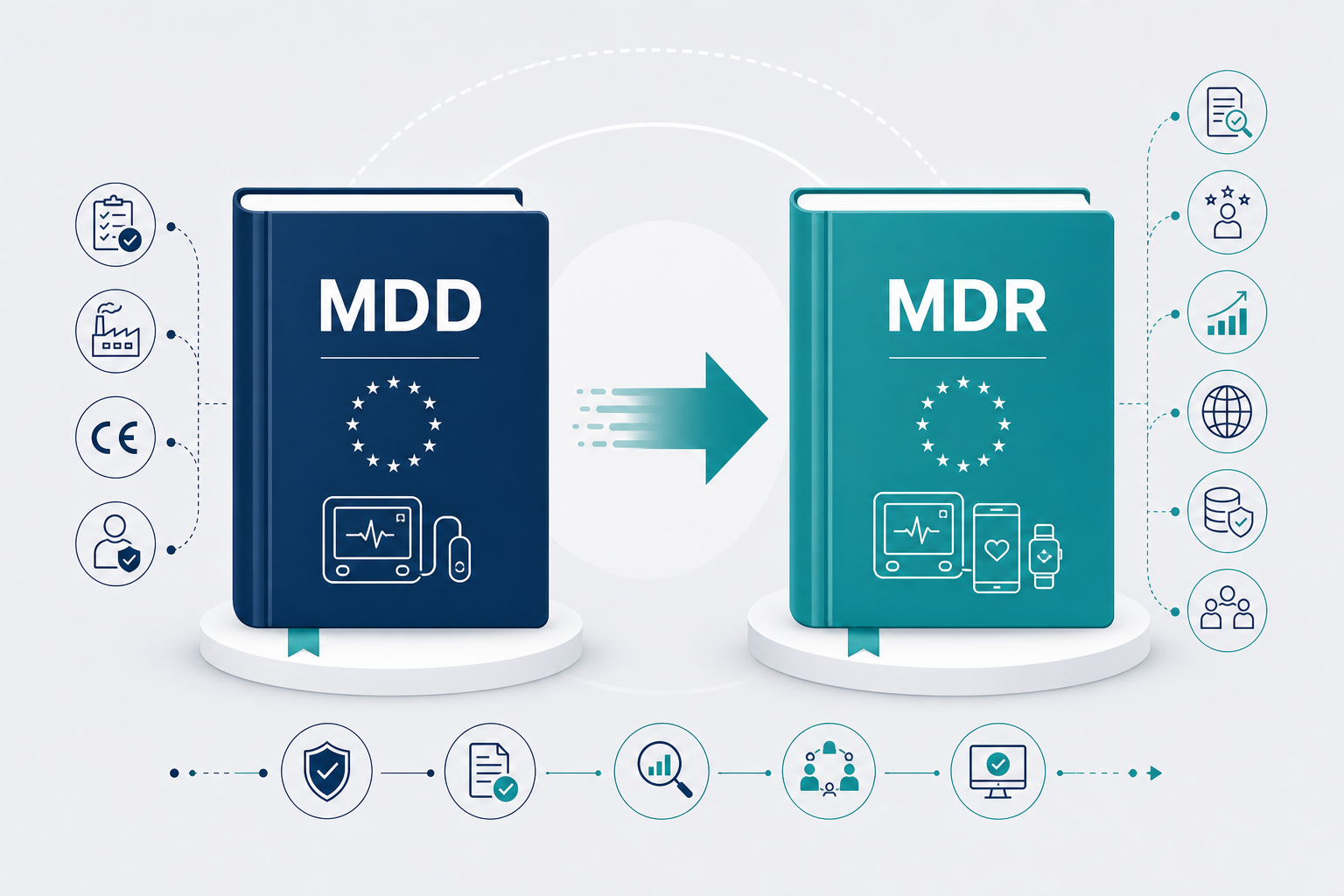
MDR vs MDD: The Differences for Manufacturers
Short answer: The MDD (93/42/EEC) was a directive — a framework each member state transposed into national law, so it was open to interpretation differences between countries. The MDR (Regulation (EU) 2017/745) is a directly binding regulation applied the same way across the EU. The MDR widened the scope, raised the clinical evidence threshold, made post-market surveillance and traceability mandatory and systematic, moved many devices up a risk class, and tightened oversight of notified bodies. MDD certificates do not carry over automatically — every device must be re-certified under the MDR.
Key takeaways
- Legal form: directive → regulation. National transposition and interpretation gaps are gone.
- Scope: the MDR clearly covers certain products without a medical purpose (Annex XVI) and software.
- Clinical evidence: relying on "equivalence" has become very restricted; Class III and implants usually need a clinical investigation.
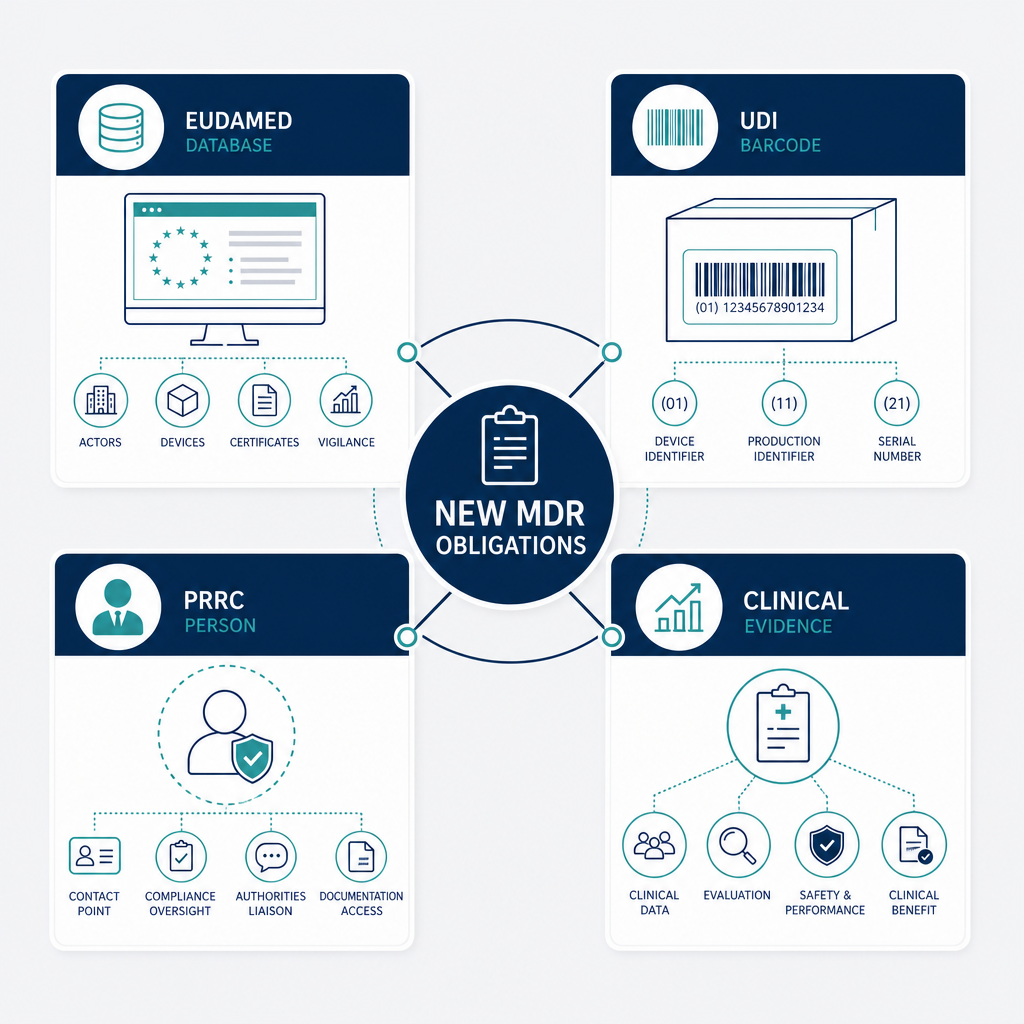
- New roles: the PRRC (Article 15) is mandatory; economic operator obligations are defined in detail.
- Traceability: UDI + EUDAMED are mandatory.
- Transition: devices certified under the MDD have conditional transition periods (see The MDR transition period).
This article is part of the What is the EU MDR? pillar guide.
What was the MDD?
The MDD (Medical Devices Directive, 93/42/EEC) was the 1993 EU directive covering general medical devices. It sat alongside two others: the AIMDD (90/385/EEC) for active implantable devices and the IVDD (98/79/EC) for in vitro diagnostics. The MDR replaced the MDD and AIMDD; the IVDD was replaced by a separate regulation, the IVDR (2017/746).
Because it was a directive, the MDD was transposed into each member state's national law. That allowed the same requirement to be read differently in different countries and produced inconsistency between notified bodies.
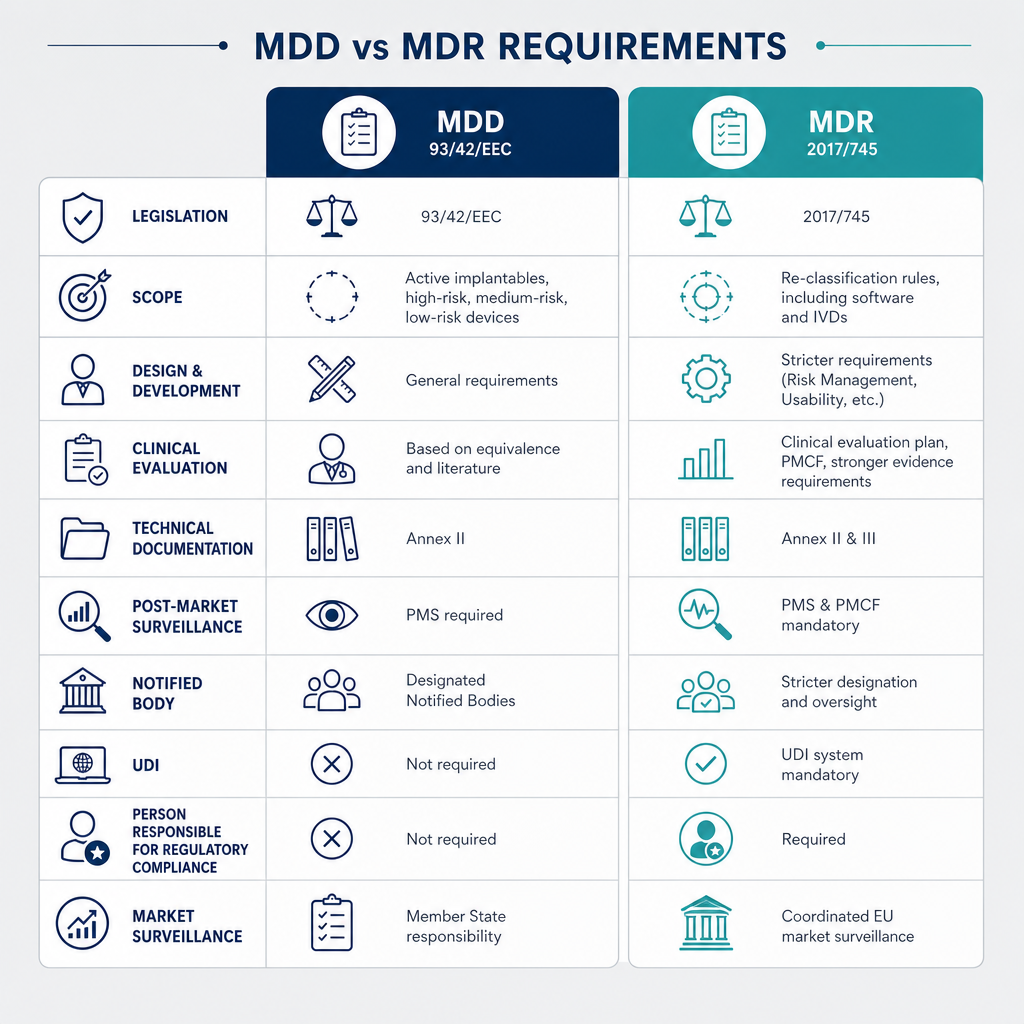
Side-by-side comparison
| Topic | MDD (93/42/EEC) | MDR (Regulation (EU) 2017/745) |
|---|---|---|
| Legal form | Directive (needs national transposition) | Regulation (directly applicable) |
| Structure | ~23 articles, 12 annexes | 123 articles, 17 annexes |
| Scope | Devices with a medical purpose | + Annex XVI products (aesthetic, etc.); software clearer |
| Classification | Annex IX, 18 rules | Annex VIII, 22 rules; many devices up-classified |
| Clinical evidence | Broad reliance on equivalence possible | Equivalence tightly restricted; Class III/implant usually clinical investigation |
| Technical file | "Design dossier" / technical documentation | Annexes II & III; contents listed in detail |
| Post-market | General obligation | Systematic: PMS plan, PSUR, PMCF, vigilance |
| Traceability | Limited | UDI + EUDAMED mandatory |
| Responsible person | No explicit requirement | PRRC mandatory (Article 15) |
| Economic operators | Partly defined | Manufacturer / authorised rep / importer / distributor each defined |
| Notified body | Lighter oversight | Re-designation, unannounced audits, sample testing |
| Transparency | Low | SSCP (Class III/implant) public in EUDAMED |
| Implant card | None | Mandatory |
What changed in practice for manufacturers
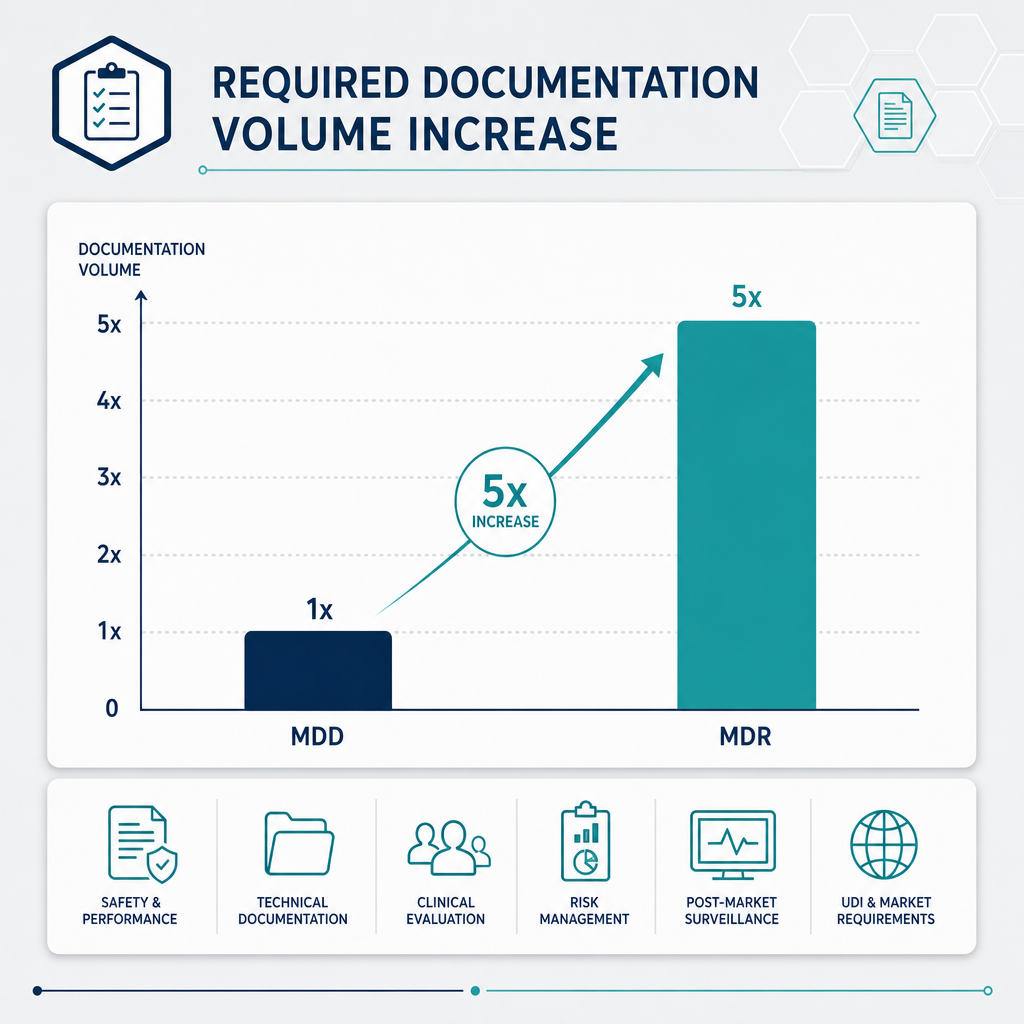
- Your clinical evaluation file grew. MEDDEV 2.7/1 rev.4 expectations are now the minimum; many products need new clinical data. No certificate without a PMCF plan.
- The GSPR replaced and expanded the "Essential Requirements." Annex I has more items, each needing concrete evidence and rationale.
- Risk management is a continuous process. The ISO 14971 file is fed by PMS data and updated across the lifecycle.
- New competence and role obligations. You must appoint a PRRC and manage suppliers and subcontractors by contract.
- Registration and traceability workload. Build the Basic UDI-DI structure, update labels with the UDI carrier, and register in EUDAMED (and ÜTS in Türkiye).
- A longer, stricter notified body process. Technical documentation deficiency cycles increased noticeably versus the MDD, and NB capacity is constrained.
"Up-classification": devices that changed class under the MDR
- Medical software — mostly Class I under the MDD; under MDR Rule 11 it can be IIa, IIb or even III.
- Spinal implants — many moved from IIb to III.
- Devices incorporating nanomaterial — Rule 19 → IIa/IIb/III.
- Devices composed of substances absorbed by the body (some dermal fillers, some surgical gels) — Rule 21 → III.
- Active therapeutic + diagnostic closed-loop devices — Rule 22 → III.
- Disinfectants and contact lens solutions — Rule 16 clarifies them as IIa/IIb.
Check rule by rule whether your class changed: Medical device classification: Classes I, IIa, IIb and III (cluster link). If the class went up, the conformity route, clinical data need and notified body scope all change.
What happens to my MDD certificate?
Valid MDD/AIMDD certificates issued before 26 May 2021 are recognised until set dates if the conditions of Regulation (EU) 2023/607 are met (31 December 2027 for Class III and implantable Class IIb; 31 December 2028 for other IIb, IIa, sterile/measuring Class I). The conditions are an MDR-compliant QMS, a timely NB application, and a signed written agreement. Detail and exceptions: The MDR transition period and deadlines (cluster link).
New devices, or devices undergoing significant changes, cannot use this bridge and are certified directly under the MDR.
How to approach the switch
- Gap analysis: map your existing MDD file against MDR Annexes I, II and III, item by item.
- Clinical strategy: is equivalence still defensible, or do you need PMCF / a clinical investigation?
- QMS update: ISO 13485:2016 plus MDR-specific procedures (UDI, EUDAMED, PMS, vigilance, PRRC).
- Timing: back-plan from the notified body queue.
Full process steps: The MDR compliance process: 8 steps to CE marking (cluster link).
Frequently asked questions
Is the MDD still in force? No. The MDD and AIMDD were repealed on 26 May 2021. Only a limited, conditional validity remains for "legacy devices" under the transitional provisions.
Can the MDR and MDD apply at the same time? A device is on the market under either the MDR or the transitional provisions; you do not obtain new certification under both.
What replaced the IVDD? Not the MDR, but a separate regulation — the IVDR (2017/746).
My device is Class I under the MDD — is it Class I under the MDR? Not necessarily. Software, measuring function and reusable surgical instruments in particular may change. Re-apply the rules.
Does the CE mark look the same under the MDD and the MDR? The mark is identical, but the conformity evidence behind an MDR CE mark is different.
How MEGACERT helps
We manage MDD-to-MDR transitions: gap analysis, clinical strategy, QMS update and notified body correspondence. Let us review your existing MDD file through an MDR lens in a free 30-minute call. → Contact
Sources
- Regulation (EU) 2017/745 on medical devices. EUR-Lex. https://eur-lex.europa.eu/eli/reg/2017/745/oj
- Council Directive 93/42/EEC (MDD) and 90/385/EEC (AIMDD). EUR-Lex.
- Regulation (EU) 2023/607 (amending the transitional provisions). EUR-Lex.
- MDCG 2021-25 — Regulation (EU) 2017/745 – application of transitional provisions. European Commission.
- European Commission. Medical devices — New regulations. https://health.ec.europa.eu/medical-devices-sector/new-regulations_en
Last updated: 30 August 2026. General information only; not a substitute for regulatory advice.