
Medical Device Classification: Classes I, IIa, IIb and III (MDR Annex VIII, 22 Rules)
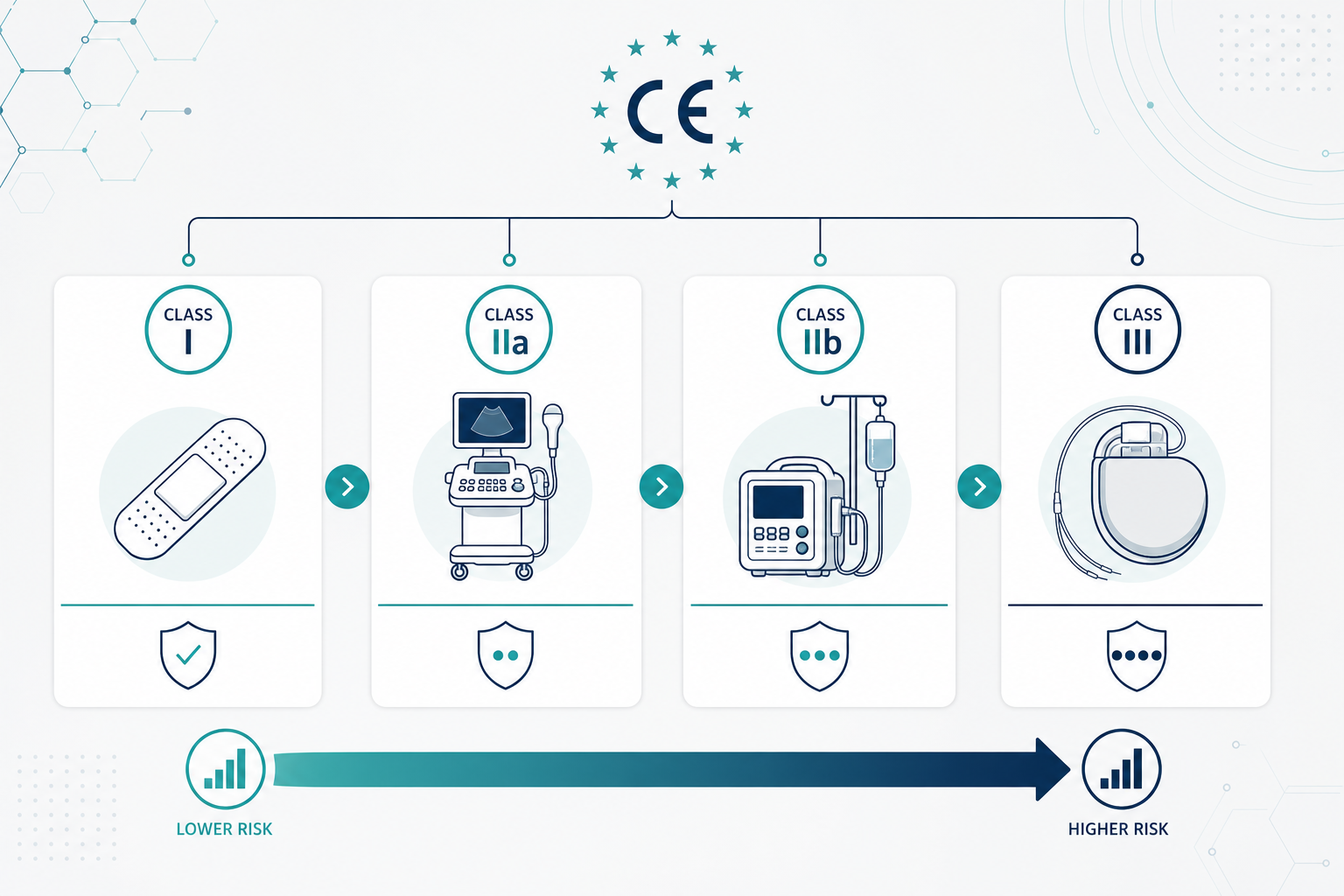
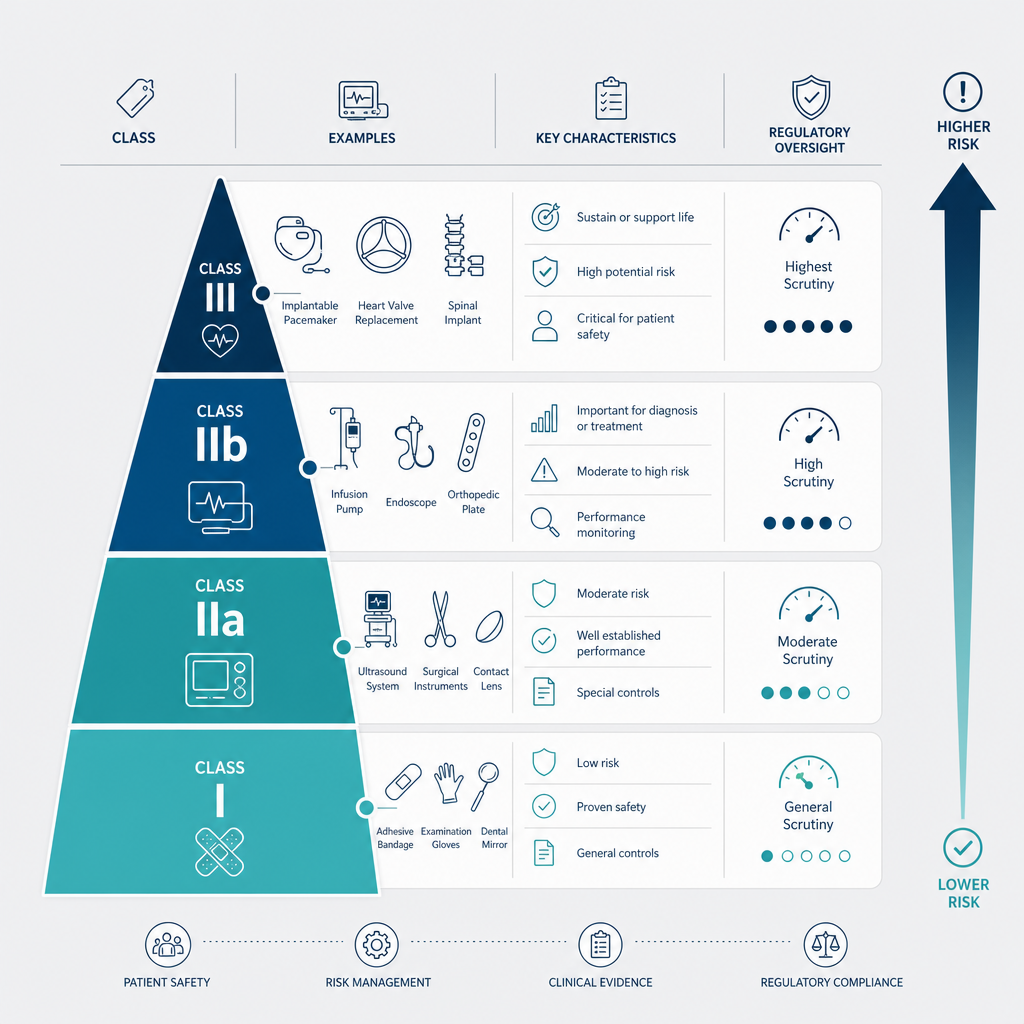
Short answer: Under the EU MDR (Regulation (EU) 2017/745), every medical device falls into one of four classes based on its intended purpose and risk: Class I (low risk), Class IIa (low–medium), Class IIb (medium–high) and Class III (high risk). The class is determined by applying the 22 classification rules in Annex VIII. It drives the conformity assessment route, whether a notified body is involved, the clinical evidence threshold, and the surveillance burden. Where more than one rule applies, the rule resulting in the higher class prevails.
Key takeaways
- Classification is not a label — it is the first decision that sets your entire regulatory pathway.
- Four classes: I, IIa, IIb, III. Class I has three sub-types: Is (sterile), Im (measuring function), Ir (reusable surgical instruments).
- The rules fall into four groups: non-invasive (1–4), invasive (5–8), active (9–13), special rules (14–22).
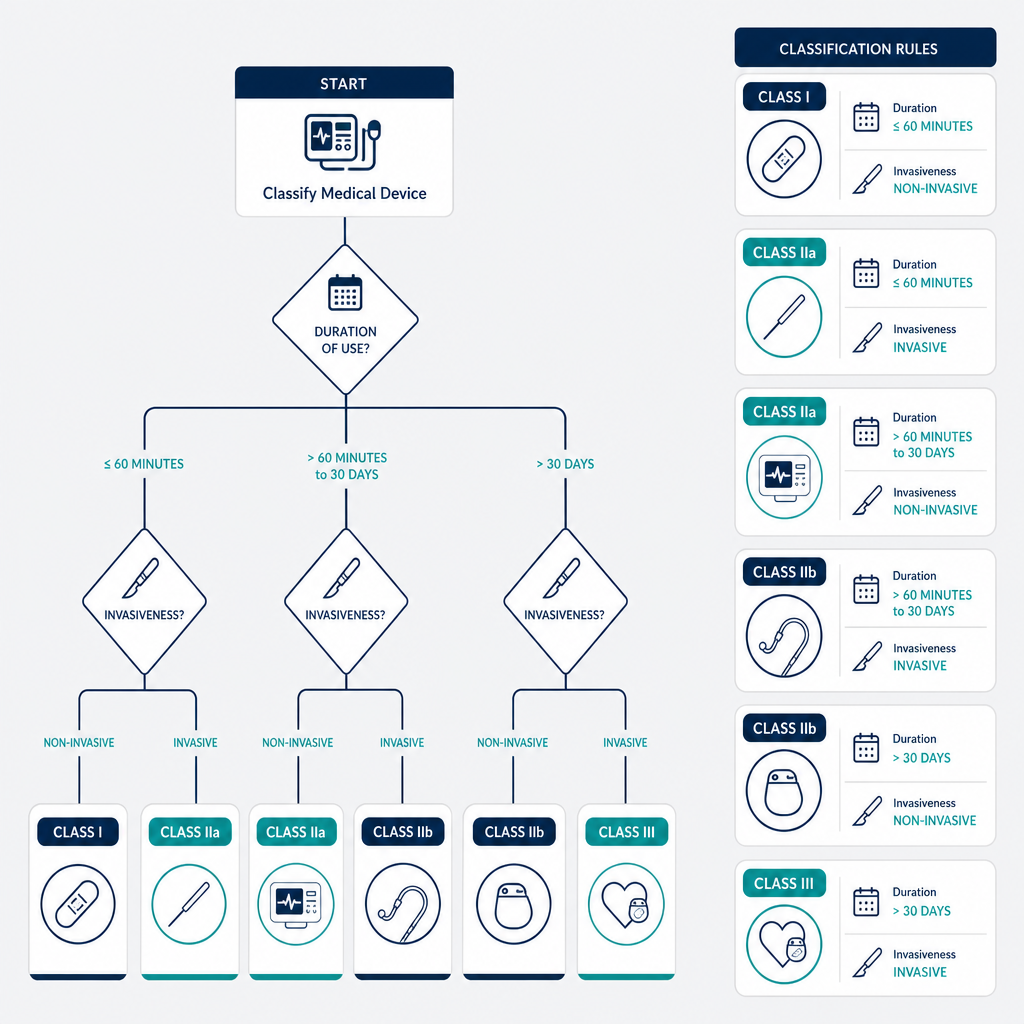
- Decisive criteria: duration of contact (transient <60 min, short term ≤30 days, long term >30 days), invasiveness and route, whether the device is active, interaction with the central circulatory/nervous system, and whether it incorporates a medicinal substance, human/animal tissue, or nanomaterial.
- Every device above Class I requires a notified body.
- The classification rationale must be documented in the technical documentation — a frequent notified body finding.
This article is part of the What is the EU MDR? pillar guide.
Why class matters so much
Your device's class determines:
| Area | Class I | Class IIa | Class IIb | Class III |
|---|---|---|---|---|
| Notified body | No (except Is/Im/Ir) | Yes | Yes | Yes |
| Typical conformity route | Self-declaration | Annex IX or Annex XI | Annex IX or Annex X+XI | Annex IX (design dossier review) or Annex X+XI |
| Clinical evidence threshold | Low | Medium | High | Very high (clinical investigation usually) |
| Technical documentation review | — | Sampling | Sampling | Every device |
| PMS reporting | PMS report | PSUR (every 2 years) | PSUR (annual) | PSUR (annual) + SSCP |
| Annual surveillance audit | — | Yes | Yes | Yes |
An incorrect (too low) classification found during an audit means rebuilding the whole file, potential withdrawal from the market, and lost time. Over-classification creates unnecessary cost. A reasoned, defensible classification is essential.
Step-by-step classification
1. Write a precise intended purpose
Classification starts not from "what the device is" but from "what the manufacturer places it on the market for." The intended purpose must state the target condition, the target body site, the user (professional or lay), the use environment, and the claimed clinical benefit. The same physical product can fall into a different class under a different intended purpose.
2. Decide device vs accessory vs part
An accessory is not a medical device on its own but is intended to be used with one; it is classified separately according to its own intended purpose. Spare parts are outside the device scope.
3. Establish duration, invasiveness and "active" status
- Duration of use/contact: transient (<60 minutes), short term (60 min – 30 days), long term (>30 days). For intermittent use, the cumulative duration applies.
- Invasiveness: surface contact, entry through a body orifice, or surgically invasive (breaching the skin or mucous membrane)?
- Active device: does it depend on electrical energy or another source of power (other than gravity) to function? Active therapeutic or active diagnostic?
4. Apply the Annex VIII rules and take the highest
Apply every rule that fits your device; if several apply, the one giving the highest class prevails.
Annex VIII: 22 rules, four groups
Non-invasive devices — Rules 1–4
| Rule | Scope | Typical outcome |
|---|---|---|
| 1 | General non-invasive devices | Class I |
| 2 | Channelling/storing blood, body liquids, organs for transfusion/transplant | Class IIa (IIb in some cases) |
| 3 | Modifying the biological/chemical composition of blood/body liquids | Class IIa/IIb (III in some cases) |
| 4 | Contact with injured skin or mucous membrane | Class I / IIa / IIb depending on wound state |
Example: examination glove → Rule 1 → Class I. A wound dressing for wounds healing by secondary intention → Rule 4 → Class IIb.
Invasive devices — Rules 5–8
| Rule | Scope | Decisive factor |
|---|---|---|
| 5 | Invasive with respect to body orifices (not surgically invasive) | Duration + orifice type |
| 6 | Surgically invasive, transient use | Usually IIa; contact with heart/central circulation/CNS → IIb–III |
| 7 | Surgically invasive, short-term use | IIa/IIb; III in specific cases |
| 8 | Implantable and long-term surgically invasive | IIb; heart/central circulation/CNS, medicinal action, biological effect, absorbable → III |
Example: single-use scalpel → Rule 6 → Class IIa. Hip implant → Rule 8 → Class III.
Active devices — Rules 9–13
| Rule | Scope | Typical outcome |
|---|---|---|
| 9 | Active therapeutic, delivering/exchanging energy | IIa; if potentially hazardous, IIb |
| 10 | Active diagnostic and monitoring | IIa; monitoring vital physiological parameters → IIb |
| 11 | Software providing information used for decisions / monitoring | IIa; serious deterioration or surgery → IIb; death or irreversible deterioration → III |
| 12 | Active devices administering/removing medicines or body liquids | IIa/IIb |
| 13 | All other active devices | Class I |
Example: digital clinical thermometer → Rule 10 → Class IIa. Radiotherapy treatment planning software → Rule 11 → Class IIb or III. For software specifics: Is your software a medical device? MDR Rule 11 (cluster link).
Special rules — Rules 14–22
These generally push specific product types into a higher class:
- 14 — devices incorporating an integral medicinal substance with ancillary action → Class III
- 15 — contraception or prevention of sexually transmitted diseases → IIb (III if implantable/long-term)
- 16 — disinfecting, cleaning, or contact lens care products → IIa/IIb
- 17 — devices using non-viable human- or animal-origin tissues or cells or their derivatives → usually Class III
- 18 — blood bags → Class IIb
- 19 — devices incorporating nanomaterial → IIa / IIb / III by exposure potential
- 20 — devices administering medicinal products by inhalation → IIa/IIb
- 21 — devices composed of substances absorbed by or locally dispersed in the body → IIa / IIb / III
- 22 — active therapeutic devices with an integrated or incorporated diagnostic function (closed loop) → Class III
The most common classification mistakes
- Narrowing the intended purpose to obtain a lower class. Auditors compare your marketing materials with your IFU; a broad claim raises the class.
- Assuming software is "Class I." After Rule 11, most software informing clinical decisions is IIa or above.
- Not summing intermittent use. If 45-minute sessions run over 10 days, you may be "long term."
- Putting an accessory in the same class as the main device. Accessories are classified on their own intended purpose.
- Not writing down the rationale. Each rule applied or excluded needs a short justification in the technical documentation.
- Deciding borderline products alone. For products on the medicine/cosmetic/biocide boundary, use the MDCG borderline manual and, if needed, the competent authority's opinion.
What happens after you set the class
- Class I (not Is/Im/Ir): compile the technical documentation, sign the declaration of conformity, register in EUDAMED, affix the CE mark. No notified body.
- Class Is / Im / Ir: the notified body assesses only the sterility, measuring function, or reuse aspect.
- Class IIa / IIb / III: full conformity assessment; the notified body performs a QMS audit plus technical documentation review. Process steps: The MDR compliance process: 8 steps to CE marking (cluster link).
If your class changed compared with the old directive, that can affect your transition: MDR vs MDD and The MDR transition period and deadlines (cluster links).
Frequently asked questions
Are "Class 2a" and "Class IIa" the same? Yes — same class, different spelling. The official notation is the Roman numeral IIa.
Who approves my class? The manufacturer classifies and justifies. The notified body checks it during conformity assessment; in a dispute, the competent authority decides.
What if several rules apply to one device? All applicable rules are considered and the one giving the highest class applies.
Can the class differ between Türkiye and the EU? Annex VIII of the Turkish Medical Device Regulation mirrors the EU MDR; in practice the class is the same.
Can classification change later? Yes — if you change the intended purpose, if new clinical data broadens the claim, or if guidance/MDCG interpretation is updated.
How MEGACERT helps
For borderline products, software (Rule 11) and reclassified devices, we prepare a reasoned classification file and build a defensible position against notified body challenges. Let us confirm your device's class with you in a free 30-minute call. → Contact
Sources
- Regulation (EU) 2017/745, Annex VIII (classification rules). EUR-Lex. https://eur-lex.europa.eu/eli/reg/2017/745/oj
- MDCG 2021-24 — Guidance on classification of medical devices. European Commission.
- MDCG 2019-11 — Qualification and classification of software. European Commission.
- Manual on borderline and classification under Regulations (EU) 2017/745 and 2017/746. European Commission.
Last updated: 30 August 2026. General information only; your classification decision requires a device-specific assessment.