
MDR Compliance Cost and Timeline: A Realistic Budgeting Guide for Manufacturers
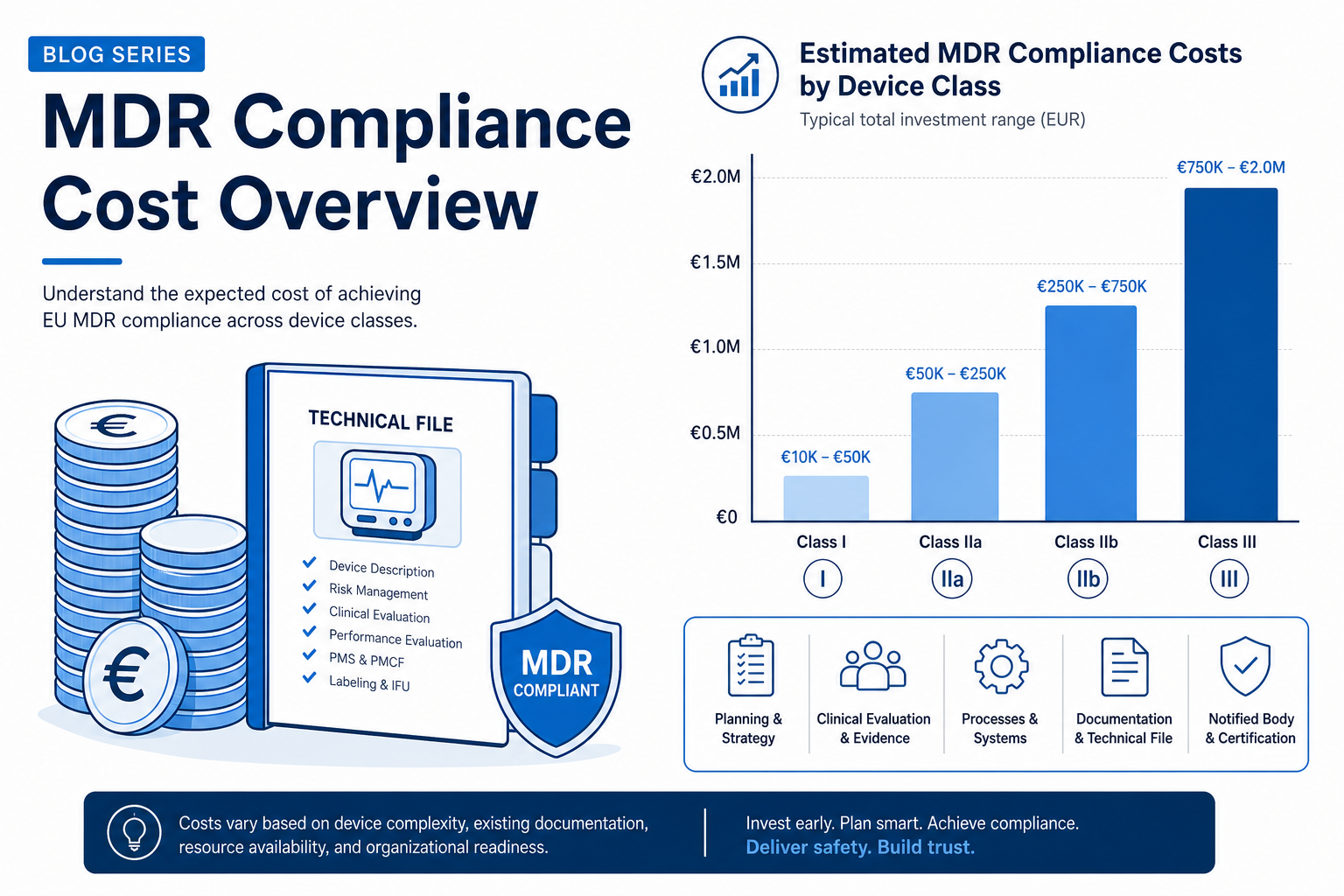
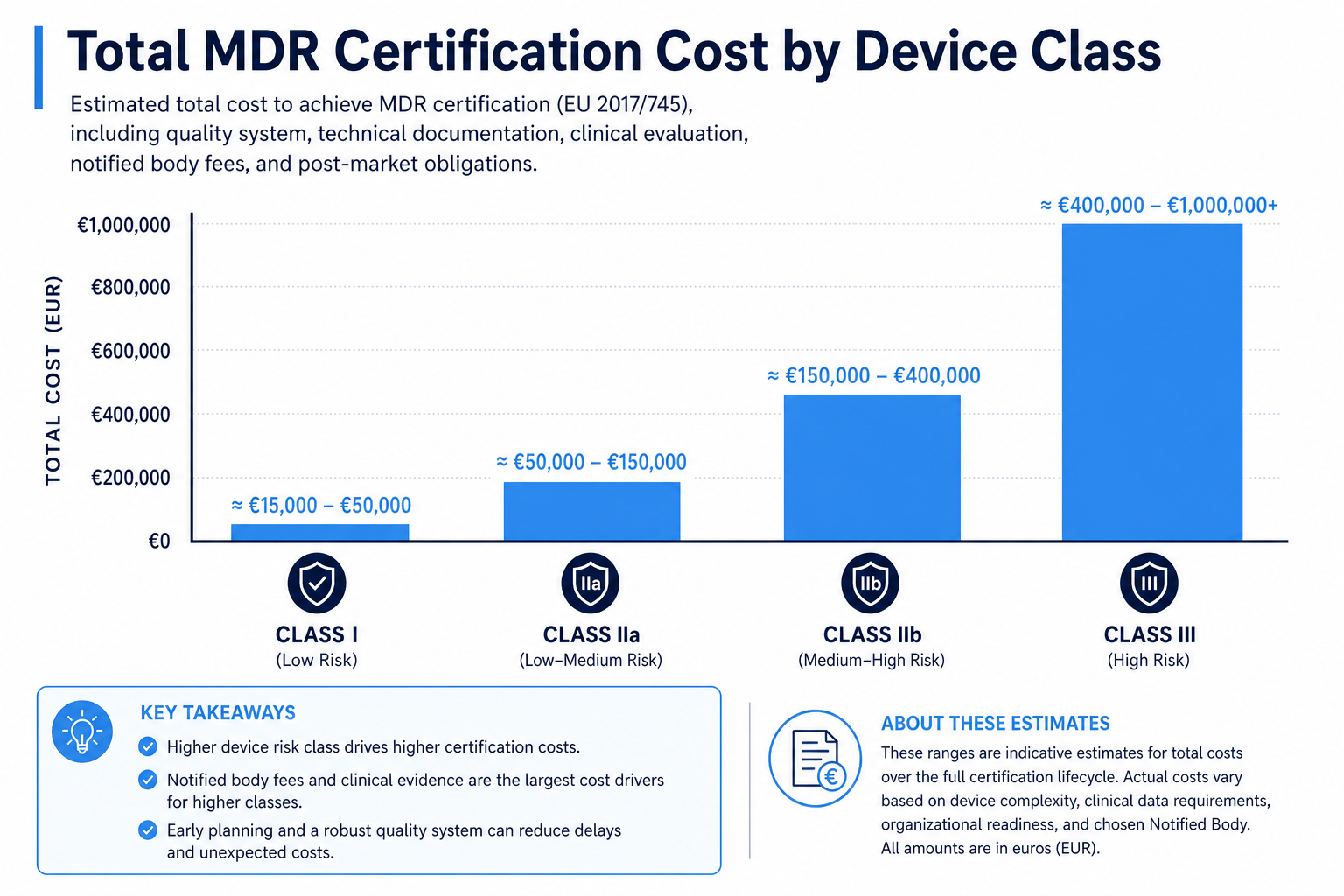
Short answer: The cost of EU MDR (Regulation (EU) 2017/745) compliance cannot be reduced to one number; it depends on device class, the maturity of your existing documentation, the testing required, and the clinical data need. As an indication: for a Class IIa device, compliance from scratch totals roughly €60,000–150,000; Class IIb is €120,000–350,000; Class III or devices needing a clinical investigation can start at €400,000 and run into the millions. The timeline is typically 12–24 months for Class IIa/IIb and 2–4 years for Class III. Annual surveillance and maintenance costs are added on top.
Method note: the ranges below are typical values observed in our consulting practice in the Türkiye and EU market as of 2026; they are not a published dataset and are not a substitute for a firm quote. For your own budget, obtain written quotes from notified bodies and test laboratories.
Key takeaways
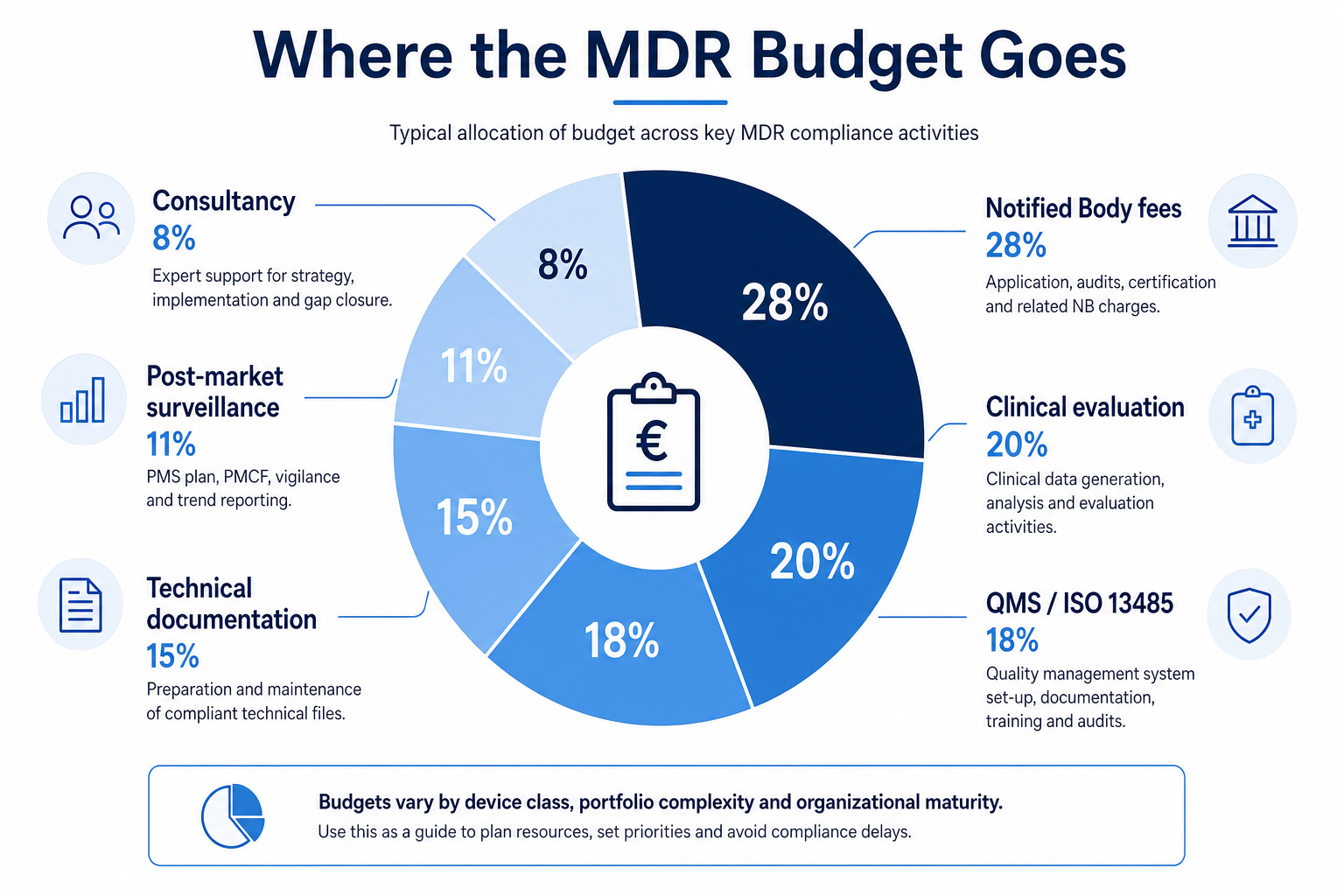
- The two biggest items: clinical evidence (especially if a clinical investigation is required) and notified body fees.
- The hidden cost: internal RA/QA staff time and the timeline stretched by deficiency cycles.
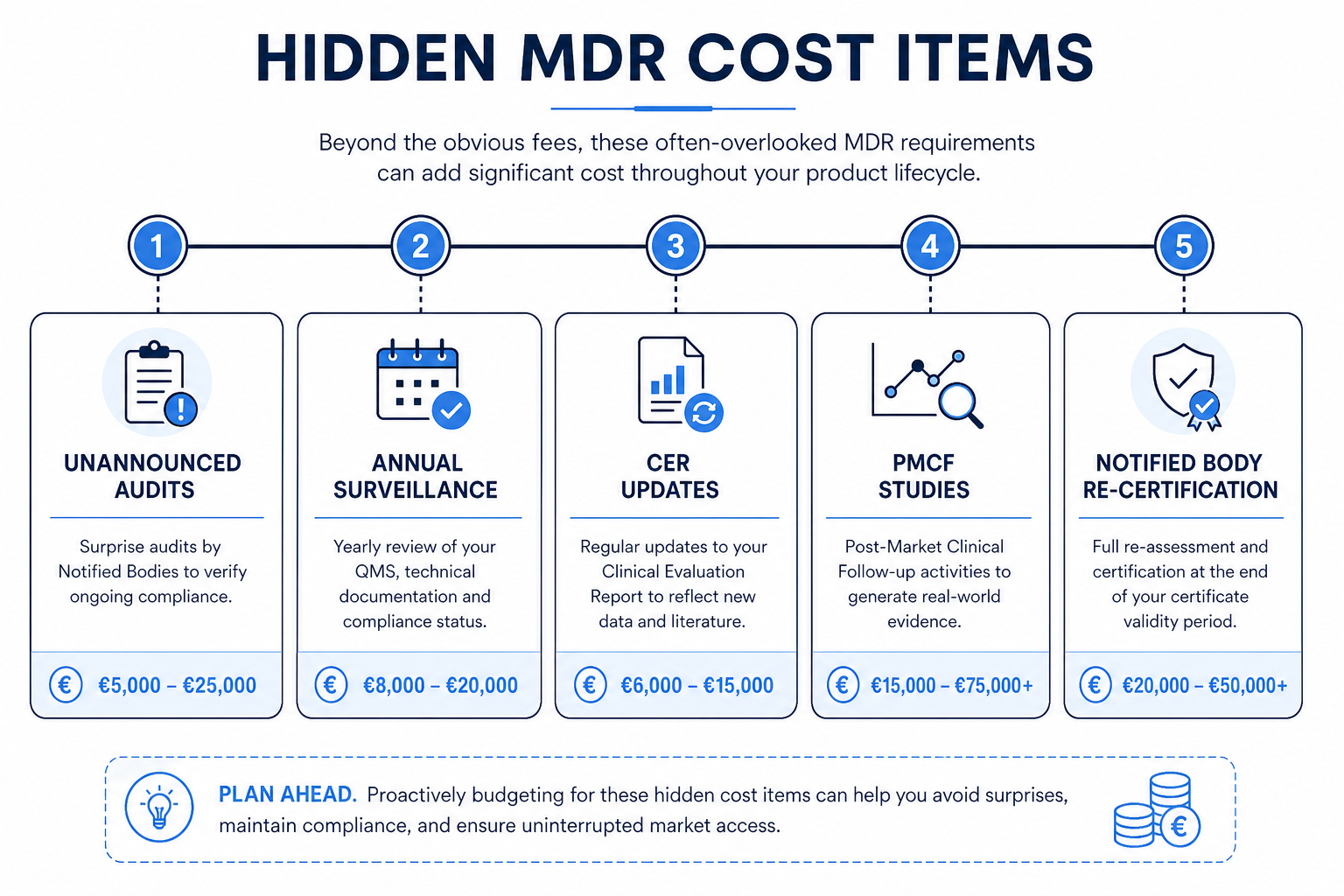
- The recurring cost: annual QMS surveillance audits, PSUR/PMCF updates, and the authorised representative fee.
- The cost of non-compliance: total loss of EU market access — usually larger than the cost of compliance.
This article is part of the What is the EU MDR? pillar and complements The MDR compliance process: 8 steps.
Cost components and indicative ranges
| Item | What it covers | Indicative range (€) |
|---|---|---|
| Gap analysis + planning | Assessing the existing file against the MDR, roadmap | 3,000 – 12,000 |
| QMS implementation / update | ISO 13485 + MDR procedures, training, documents, (optional) eQMS software | 15,000 – 60,000 |
| ISO 13485 certification (NB) | Initial certification audit | 8,000 – 20,000 |
| Biocompatibility (ISO 10993) | Material characterisation + required tests | 10,000 – 80,000+ |
| Electrical safety / EMC (IEC 60601) | Type testing for active devices | 15,000 – 45,000 |
| Software validation (IEC 62304/62366) | MDSW lifecycle, usability | 10,000 – 60,000 |
| Shelf life / stability, sterilisation validation | Accelerated + real time, ISO 11135/11137 | 8,000 – 40,000 |
| Clinical evaluation (CER) | Literature appraisal, CER writing, PMCF plan | 8,000 – 40,000 |
| Clinical investigation (if required) | Protocol, ethics/authority approval, sites, monitoring, statistics | 100,000 – 1,000,000+ |
| Notified body conformity assessment | QMS + technical documentation/design review (initial) | IIa: 15,000–40,000 · IIb: 25,000–70,000 · III: 50,000–150,000+ |
| Authorised representative (EC REP) + PRRC | EU legal representation, annual | 3,000 – 15,000 / year |
| Internal staff time | RA/QA, engineering, project management (opportunity cost) | Usually 20–40% of total budget |
| Consulting | Comprehensive support or specific work packages | 15,000 – 120,000 |
Rough total by class (from scratch, single device)
| Class | Initial compliance total (€) | Typical timeline |
|---|---|---|
| Class I (not Is/Im/Ir) | 8,000 – 30,000 | 3–8 months |
| Class I (Is/Im/Ir) | 20,000 – 60,000 | 6–12 months |
| Class IIa | 60,000 – 150,000 | 12–20 months |
| Class IIb | 120,000 – 350,000 | 14–24 months |
| Class III | 400,000 – several million | 24–48 months |
Note: grouping several variants of the same technical documentation family into one submission lowers the per-device cost.
Annual maintenance costs
- QMS surveillance audit (NB): €4,000 – 10,000 / year
- PSUR / PMCF updates: €3,000 – 20,000 / year (by class and data volume)
- Authorised representative fee: €3,000 – 15,000 / year
- EUDAMED / ÜTS registration maintenance, UDI updates: low but continuous
- Recertification (every 5 years) and significant-change reviews
Factors that drive the cost
- Device class and contact — implantable and Class III devices are the most expensive.
- Clinical data position — a manufacturer with its own data finishes far cheaper than one needing a clinical investigation.
- Existing documentation maturity — a well-kept MDD file lowers gap analysis and cost.
- Portfolio strategy — grouping variants, retiring low-volume SKUs.
- Notified body choice and queue — scope match and responsiveness directly affect the timeline.
- Internal capacity — an experienced RA/QA team reduces the consulting need.
How to keep the budget under control
- Do an early gap analysis to bring surprises forward.
- Optimise the testing strategy with literature and material characterisation; avoid unnecessary tests.
- Set the clinical strategy up front: is equivalence defensible, or is PMCF the route?
- Sign with a notified body early and get in the queue.
- Group variants into one technical file.
- Phase the budget: spread it by year; smooth testing and NB fees across cash flow.
Frequently asked questions
Is there a single price for a "CE certificate"? No. The notified body fee is only one part of the total; testing, clinical and QMS items are often larger.
Does consulting pay for itself? For teams doing the MDR process for the first time, it usually produces a net saving by reducing deficiency cycles and rework — but this depends on the device and the team.
Are there discounts or grants for SMEs? Some notified bodies and public support programmes (e.g. export/R&D incentives) may partly cover certain items; check current programmes.
The most effective way to shorten the timeline? Complete the clinical data and GSPR evidence early, and apply to a notified body early.
How MEGACERT helps
We build a device-specific cost–timeline model, optimise the testing and clinical strategy, and help you compare notified body quotes. Let us set a realistic budget range in a free 30-minute call. → Contact. What a consultant does: What does an MDR consultant do, and when do you need one? (cluster link)
Sources
- Regulation (EU) 2017/745, Annexes IX–XI (conformity assessment) and Annex VII (notified body requirements). EUR-Lex.
- MDCG 2022-14 — Commission/NB status reports on MDR and IVDR capacity and access.
- Notified body public fee schedules (e.g. TÜV SÜD, BSI, TSE, UDEM, Szutest) — request a current quote from the body concerned.
- Test laboratory quotations (biocompatibility, EMC, software) — project-specific.
Last updated: 30 August 2026. Figures are indicative and not a substitute for a firm quote.