

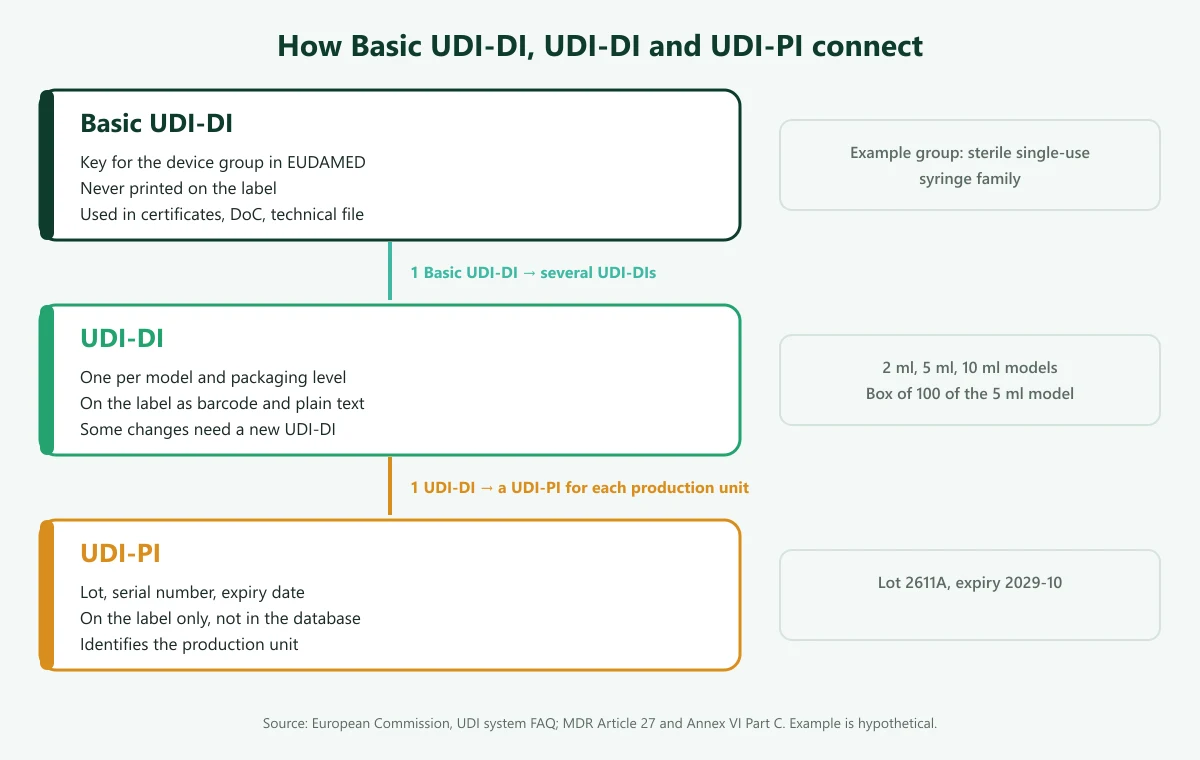
A UDI (Unique Device Identifier) is a series of numeric or alphanumeric characters, created under a globally accepted coding standard, that identifies one specific medical device on the market without ambiguity. Under the EU Medical Device Regulation (MDR, 2017/745) a UDI has two parts: the UDI-DI, which identifies the device model, and the UDI-PI, which identifies the production unit (lot, serial number, expiry date). The EU adds a third key that never appears on a label: the Basic UDI-DI, which identifies a group of devices (European Commission, UDI FAQ).
This guide is for manufacturers placing devices on the EU market and the regulatory and quality teams who prepare their labels and EUDAMED data. It explains how the three identifiers fit together, the label and direct marking dates, which changes trigger a new UDI-DI, and how UDI connects to the EUDAMED UDI/device module, mandatory since 28 May 2026. Article references are to the MDR; the IVDR has parallel provisions in Article 24.
Photographs in this article are illustrative and AI-generated; the diagram is an original MEGACERT graphic.
Key takeaways
- UDI = UDI-DI + UDI-PI. The Basic UDI-DI is not printed on labels; it is the key for the device group in EUDAMED, certificates, the EU declaration of conformity and the technical documentation.
- Four issuing entities. UDIs must follow the rules of one of four entities designated by the Commission: GS1, HIBCC, ICCBBA or IFA. Their designations run until 27 June 2029.
- Labels: UDI carriers have been required on labels since 2021 for class III and implantable devices, 2023 for class IIa and IIb, and 26 May 2025 for class I.
- Next deadline: direct marking of reusable class I devices applies from 26 May 2027.
- EUDAMED: the UDI/device module has been mandatory since 28 May 2026. Devices first placed on the market before that date, with further units placed on the market after it, must be registered by 28 November 2026.
What is a UDI, and what are its parts?
Article 27 MDR sets out four elements of the UDI system: producing the UDI; placing the UDI carrier on the label, the packaging or, for reusable devices, the device itself; storage of UDIs by economic operators and health institutions; and the UDI database that forms part of EUDAMED (European Commission, UDI FAQ).
The three identifiers do different jobs:
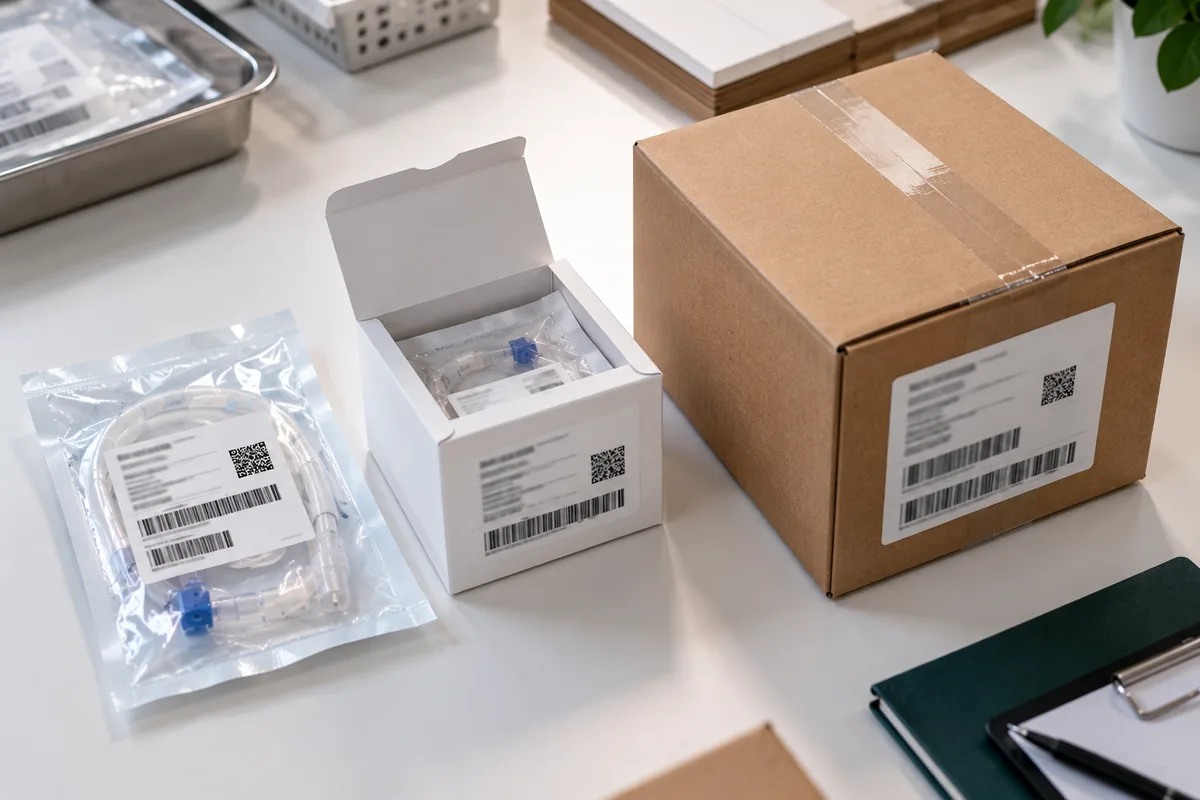
- UDI-DI (device identifier) is the static part, specific to the manufacturer and the device model. It is the access key to the device data in EUDAMED. Each model and each packaging level (single pouch, box, case) has its own UDI-DI.
- UDI-PI (production identifier) is the variable part: lot number, serial number, software identification, manufacturing date or expiry date. UDI-PI data is never entered in the UDI database; it lives on the label and in the barcode.
- Basic UDI-DI identifies and connects devices with the same intended purpose, risk class and essential design and manufacturing characteristics. It is independent of packaging and labelling and does not appear on any trade item.
The UDI carrier is how the UDI appears on the label: an automatic identification and data capture (AIDC) format, such as a DataMatrix barcode, together with a human readable interpretation (HRI) in plain text (European Commission, UDI FAQ).
A worked example (hypothetical). Under GS1 rules, the human-readable form of a UDI could read \`(01)09520123456788(17)281231(10)2611A(21)000123\`, using the GS1 example prefix 952. The part after (01) is the GTIN, which serves as the UDI-DI. The remaining application identifiers form the UDI-PI: (17) the expiry date, 31 December 2028; (10) the lot number; and (21) the serial number. The same data sits in the DataMatrix barcode next to it. HIBCC, ICCBBA and IFA use their own formats.
What is the Basic UDI-DI, and why is it not on the label?
The Basic UDI-DI is the main key for device records in EUDAMED. It is referenced in certificates (including certificates of free sale), the EU declaration of conformity, the technical documentation and the summary of safety and clinical performance (European Commission, UDI page). Under Article 29 MDR, the manufacturer assigns a Basic UDI-DI before placing the device on the market and provides it to the UDI database with the Annex VI Part B core data.
Because it stands for a group rather than a product, the Basic UDI-DI is never printed on a label. Each UDI-DI belongs to one Basic UDI-DI only. How you group devices under Basic UDI-DIs shapes your certificate scope and technical file, so settle the grouping first; our overview of MDR compliance documents lists what the file needs. The Commission points to MDCG 2018-1 Rev.4 for the detailed rules.
| Basic UDI-DI | UDI-DI | UDI-PI | |
|---|---|---|---|
| Identifies | The device group | The model and packaging level | The production unit (lot, serial, dates) |
| On the label? | No | Yes, barcode and plain text | Yes, barcode and plain text |
| Entered in EUDAMED? | Yes, as the main key | Yes | No |
| Used in documents | Certificates, EU DoC, technical file, SSCP | Labels, sales, ordering | Labels, traceability records |
Who issues UDIs?
The manufacturer creates its own UDIs, but only under the rules of an issuing entity designated by the Commission. Implementing Decision (EU) 2019/939 designated four: GS1, HIBCC, ICCBBA and IFA. Implementing Decision (EU) 2024/2120 renewed those designations for five more years, until 27 June 2029 (European Commission, UDI page).
In practice the manufacturer joins one of these organizations, obtains a company prefix and builds its Basic UDI-DIs and UDI-DIs under that organization's rules. The choice is the manufacturer's, and it determines the barcode format and Basic UDI-DI structure. The Commission publishes each entity's UDI and Basic UDI-DI formats on its UDI page.
When did UDI labelling become mandatory?
The obligation to assign UDIs has applied since 26 May 2021. Placing the UDI carrier on the label, and direct marking of reusable devices, were phased in by risk class (European Commission, UDI FAQ; MDR Article 123(3)(f) and (g)):
| Obligation | Class III and implantable | Class IIa and IIb | Class I |
|---|---|---|---|
| UDI carrier on the label | 26 May 2021 | 26 May 2023 | 26 May 2025 |
| Direct marking of reusable devices | 26 May 2023 | 26 May 2025 | 26 May 2027 |
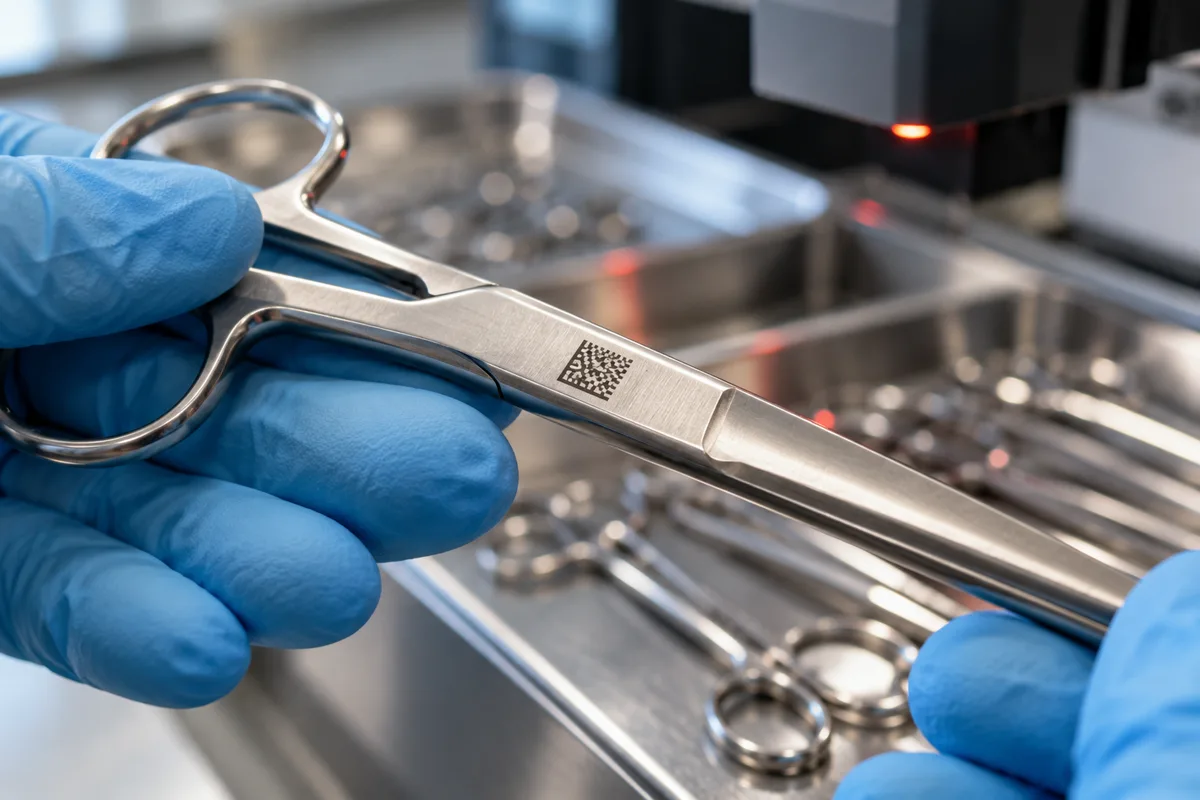
Every Regulation device except custom-made and investigational devices must now carry a UDI, whatever its class, subject to the label exceptions below. The next deadline is direct marking of reusable class I devices, such as surgical hand instruments: 26 May 2027.
### Direct marking rules
Reusable devices must carry the UDI carrier on the device itself. For devices that need disinfection, sterilization or refurbishing between patients, the marking must be permanent and readable after each reprocessing cycle throughout the device's intended lifetime. There are two exemptions: when any type of direct marking would interfere with the safety or performance of the device, and when direct marking is not technologically feasible (European Commission, UDI FAQ). If you rely on an exemption, document the justification in the technical file.
### Label and packaging rules
- The UDI carrier goes on the device label and on all higher levels of packaging, and each higher level has its own UDI. The exceptions (shipping containers, limited space, single-use class I and IIa, retail packaging) are listed under "Exceptions and transitional provisions" below.
- If a lot number, serial number, software identification or expiry date appears on the label, it must be part of the UDI-PI. Active implantable devices must include at least the serial number in the UDI-PI.
Which changes require a new UDI-DI?
A new UDI-DI is needed whenever a change could lead to misidentification of the device or ambiguity in its traceability. The Commission lists changes to these elements in particular (European Commission, UDI FAQ; MDCG 2018-1 Rev.4):
- Name or trade name
- Device version or model
- Labelled as single use
- Packaged sterile
- Need for sterilization before use
- Quantity of devices in a package
- Critical warnings or contraindications
- CMR substances or endocrine disruptors
- The maximum number of reuses, for devices where it is determined
Containing latex or DEHP is the example given for critical warnings, and MDCG 2018-1 adds the maximum number of reuses as a further trigger (MDCG 2018-1 Rev.4).
For changes that do not need a new UDI-DI, the manufacturer must update the EUDAMED record within 30 days (MDR, Annex VI Part C). A new UDI-DI also matters for EUDAMED's "same device" rule: under the Commission's EUDAMED Q&A, if a change made in the Regulation version leads to a new UDI-DI, the legacy device and the Regulation device are not "the same device", so the legacy device must be registered separately (EUDAMED Q&A).
Exceptions and transitional provisions
The EU has no case-by-case exemption procedure for UDI. Every device is in principle subject to the UDI rules, with only the exceptions written into the Regulation (European Commission, UDI FAQ).
### Which devices and labels are exempt?
The label exceptions below come from MDR Annex VI Part C, section 4, as summarised in the Commission UDI FAQ (MDR; European Commission, UDI FAQ).
- Custom-made and investigational devices are outside the UDI system and are not registered in the EUDAMED UDI/device module (EUDAMED Q&A, Q7).
- Shipping containers do not need a UDI carrier.
- Significant space constraints on the unit-of-use packaging allow the UDI carrier to move to the next higher packaging level. Where both formats do not fit, only the AIDC format is required; for home-use devices the plain-text HRI must still appear.
- Individually packaged single-use class I and IIa devices may carry the UDI on a higher packaging level, unless users such as home-care patients will not see that level.
- Retail-only devices do not need the UDI-PI in AIDC form on point-of-sale packaging (MDR, Annex VI Part C, section 4).
- Readable through the packaging: if the device's UDI carrier can be read or scanned through its packaging, the packaging does not need its own carrier (European Commission, UDI FAQ).
### Systems, procedure packs and configurable devices
- Systems and procedure packs (Article 22): the producer assigns a Basic UDI-DI to the pack and registers it in EUDAMED with the Annex VI Part B core data (Article 29(2) MDR); MDCG 2018-4 describes those elements for systems and procedure packs.
- Configurable devices: one UDI is assigned to the configurable device in its entirety, and each individual configurable device gets its own UDI-PI (MDR, Annex VI Part C, section 6.4; European Commission, UDI FAQ).
- Software: MDCG 2018-5 explains which software changes need a new UDI-DI and which need only a new UDI-PI.
### Transitional provisions
- UDI assignment has applied since 26 May 2021; the label and direct marking dates in the table above are the phased deadlines of Article 123(3)(f) and (g).
- Legacy devices are devices still placed on the market under Article 120(3): with a valid Directive certificate, or as class I devices with a declaration of conformity drawn up before 26 May 2021 that need a notified body under the MDR. They are not subject to MDR UDI obligations. They must still be registered in EUDAMED, identified by a EUDAMED ID or a UDI-DI (European Commission, UDI FAQ, question 7; EUDAMED Q&A).
- Devices no longer placed on the market when the UDI/device module became mandatory do not need to be registered, unless a post-market surveillance or vigilance action occurs (EUDAMED Q&A, Q8).
- IVDs follow separate dates under IVDR Article 113(3)(e); for class A IVDs the label deadline is 26 May 2027.
How does UDI connect to EUDAMED registration?
Commission Decision (EU) 2025/2371 confirmed the EUDAMED UDI/device module as functional, and its use has been mandatory since 28 May 2026 (European Commission, EUDAMED). For UDI this means two things:
- Regulation devices whose first unit is placed on the market on or after 28 May 2026 must be registered in the UDI/device module before that first unit is placed on the market.
- Regulation and legacy devices first placed on the market before 28 May 2026, with further units placed on the market after that date, must be registered by 28 November 2026 (Commission transition chart). One registration per UDI-DI covers all units, and a legacy device does not need its own registration if "the same device" is already registered as a Regulation device (EUDAMED Q&A, Q7 and Q8).

The registration covers the Basic UDI-DI and each UDI-DI linked to it, with the Annex VI data; UDI-PIs are not entered. Our guide to EUDAMED registration in 2026 covers the deadlines and decision tree in detail.
UDI obligations of economic operators and health institutions
Almost all UDI obligations sit with the manufacturer: assigning the UDI and Basic UDI-DI, placing the carrier, registering in EUDAMED and keeping the record current. Other operators have narrower duties (European Commission, UDI FAQ):
- Importers and distributors verify that the manufacturer has assigned a UDI, where applicable.
- Distributors or importers that translate or repackage devices must make sure the work does not compromise the readability of the UDI carrier.
- All economic operators and health institutions store, preferably electronically, the UDIs of class III implantable devices they have supplied or been supplied with.
See our guide to MDR economic operators for each role in detail, and our MDR consultancy page (in Turkish) for support with technical documentation.
A six-step UDI readiness checklist
- Choose an issuing entity and obtain your company prefix.
- Define your Basic UDI-DI groups by intended purpose, risk class and essential design, consistent with your certificate and EU declaration of conformity scope.
- Generate UDI-DIs for every model and packaging level and map them to their Basic UDI-DI in one master data table.
- Update labels. Place the barcode and plain text, and structure lot, serial and date data under the UDI-PI rules; verify that barcodes scan.
- List your reusable devices. For class I, choose a direct marking method before 26 May 2027 and test readability after reprocessing cycles.
- Complete EUDAMED registration. Meet the 28 November 2026 deadline for devices first placed on the market before 28 May 2026 with further units placed on the market after it, and write the 30-day update rule into your procedures.
Frequently asked questions
Is a UDI the same as a barcode?
No. The UDI is an identification number; the barcode is a machine-readable (AIDC) representation of it. On the label the UDI appears both as a barcode and as plain text.
Is the Basic UDI-DI printed on the label?
No. The Basic UDI-DI does not appear on any trade item. It is used in EUDAMED and in certificates, the EU declaration of conformity and the technical documentation.
Do custom-made devices need a UDI?
No. The UDI system applies to all devices except custom-made devices and devices for clinical investigation or performance studies (European Commission, UDI FAQ).
How is a UDI assigned to software?
The UDI is assigned at the system level of the software. The rule covers two groups: software that is commercially available on its own, and software that is a device in itself. The software identification is treated as the manufacturing control mechanism and shown in the UDI-PI (European Commission, UDI FAQ).
Sources
- European Commission, Unique Device Identification (UDI) System: Frequently Asked Questions (dated 2020; accessed 20 October 2026). Definitions, carrier dates and changes that need a new UDI-DI.
- European Commission, Unique Device Identifier (UDI) page. Issuing entities and Implementing Decision (EU) 2024/2120; accessed 20 October 2026.
- MDCG 2018-4, UDI core elements for systems or procedure packs, October 2018; accessed 20 October 2026.
- MDCG 2018-5, UDI assignment to medical device software, October 2018; accessed 20 October 2026.
- MDCG 2018-1 Rev.4, Guidance on Basic UDI-DI and changes to UDI-DI, April 2021; accessed 20 October 2026.
- Regulation (EU) 2017/745 (MDR), consolidated text of 10.01.2025. Articles 27, 29 and 123 and Annex VI; accessed 20 October 2026.
- Commission Decision (EU) 2025/2371, Official Journal, 27.11.2025; accessed 20 October 2026.
- European Commission, EUDAMED overview; accessed 20 October 2026.
- European Commission, transition chart for devices placed on the market before mandatory use; accessed 20 October 2026.
- Q&A on the gradual roll-out of EUDAMED, published on the Commission's website (not formally endorsed); accessed 20 October 2026.
About the author
Ersin Çetin is an MDR / CE Marking Consultant at MEGACERT, advising medical device manufacturers on technical documentation, MDR compliance and EU market entry. That advice draws on a background in food engineering and more than 25 years as a lead auditor, including for ISO 9001, ISO 14001, ISO 22000, ISO 45001, ISO 50001, ISO/IEC 27001 and ISO 14064. Reviewed by Eren İşman, a mechanical engineer and lead auditor with more than 25 years of experience. Eren İşman is a MEGACERT employee, so this is an internal review. Photographs in this article are illustrative and AI-generated. Last updated: 20 October 2026. This article reflects EU legislation and European Commission documents in force on 20 October 2026. MEGACERT is a consultancy: it is not a notified body, does not issue CE certificates and is not a UDI issuing entity. For help with UDI and EUDAMED registration, contact us.
Editorial standards: we cite EU legislation and European Commission or MDCG documents directly and date every source. If you find an error, tell us through the contact page and we will correct it.