

EUDAMED registration has been a legal obligation for manufacturers, authorised representatives and importers placing medical devices on the EU market since 28 May 2026. Commission Decision (EU) 2025/2371, published in the Official Journal on 27 November 2025, confirmed that four EUDAMED modules are functional: actor registration, UDI/device registration, notified bodies and certificates, and market surveillance. That publication started a six-month transition. This guide explains which devices must be registered by when, who the 28 November 2026 deadline applies to, and what to prepare in the 42 days left as of 17 October 2026, using the regulation text and the Commission's own documents. Article references are to the MDR; the IVDR contains parallel transitional provisions in Article 113(3).
Key takeaways
- Four EUDAMED modules have been mandatory since 28 May 2026: actor registration, UDI/device registration, notified bodies and certificates, and market surveillance.
- Devices first placed on the EU market before 28 May 2026 and still being placed on it must be registered in the Unique Device Identification (UDI)/device module by 28 November 2026, according to the Commission's transition timeline.
- An MDR device whose first unit is placed on the market on or after 28 May 2026 must be registered before that first unit is placed.
- Notified bodies have until 28 May 2027 to enter the latest version of each MDR certificate issued before mandatory use (MDR Article 123(3)(ea)).
- The vigilance and clinical investigation modules are not mandatory yet, and the Commission says neither will have a voluntary phase.
What is EUDAMED and what changed in 2026?
EUDAMED, the European Database on Medical Devices, is the IT system set up by Regulation (EU) 2017/745 (MDR) and Regulation (EU) 2017/746 (IVDR). It has six modules and brings actor, device, certificate, vigilance and clinical investigation data into one system, much of it visible to the public.
The legal change behind 2026 is Regulation (EU) 2024/1860. It replaced MDR Article 34(1) and (2) and amended Article 123(3), so that EUDAMED can be rolled out module by module instead of waiting until the last of the six modules is completed. The obligations linked to a module apply six months after the Commission publishes a notice in the Official Journal confirming that the module is functional (Regulation 2024/1860, amending MDR Article 123(3)(d)).
The Commission issued that notice as Decision (EU) 2025/2371 of 26 November 2025. It was published on 27 November 2025 and confirmed four systems as functional, based on an independent audit report dated 18 June 2025 (Decision 2025/2371). The Commission's EUDAMED page states that the four modules have been mandatory to use since 28 May 2026 (European Commission, EUDAMED overview).
From that date, the national registration rules that applied under Directives 93/42/EEC and 90/385/EEC gave way to EUDAMED for these modules. The Q&A on the gradual roll-out of EUDAMED, published on the Commission's website, adds that where a device is registered both nationally and in EUDAMED, the EUDAMED registration becomes the legally required one once the module is mandatory. The Q&A states that it has not been formally endorsed by the Commission, so treat it as practical guidance rather than law (Q&A on the gradual roll-out of EUDAMED, Q9).
Which EUDAMED modules are mandatory and which are not?
Four of the six modules are mandatory. The other two are not: post-market surveillance and vigilance, and clinical investigations and performance studies. The Commission has said both will be released only when they become mandatory, with no voluntary period first.
| Module | Status | Who it concerns |
|---|---|---|
| Actor registration | Mandatory since 28 May 2026 (voluntary since December 2020) | Manufacturers, authorised representatives, importers, system and procedure pack producers |
| UDI/device registration | Mandatory since 28 May 2026 (voluntary since October 2021) | Manufacturers |
| Notified bodies and certificates | Mandatory since 28 May 2026 | Notified bodies |
| Market surveillance | Mandatory since 28 May 2026 | Competent authorities and the Commission |
| Post-market surveillance and vigilance | In development; the roadmap shows an Official Journal notice in Q4 2026 and mandatory use in Q2 2027, subject to change after the audit | Economic operators reporting vigilance data |
| Clinical investigations and performance studies | Under analysis | Sponsors of clinical investigations and performance studies |
The vigilance dates are not fixed. The Commission's roadmap notes that the timeline may be updated depending on audit results (EUDAMED roadmap). Until the vigilance module is mandatory, serious incident and field safety corrective action reports continue to go to national competent authorities through the existing routes, as Article 123(3)(d) provides.
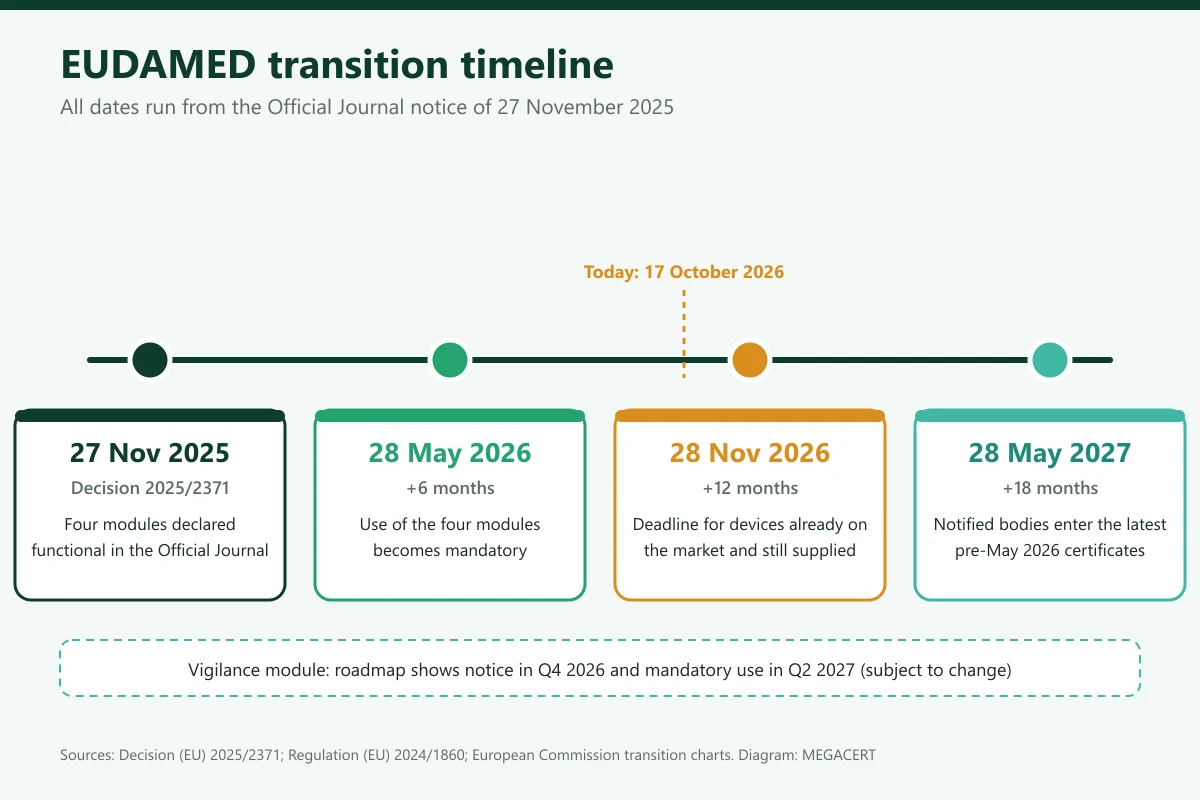
The EUDAMED deadlines: 28 May 2026, 28 November 2026, 28 May 2027
All three dates run from the same publication on 27 November 2025, and the Commission counts mandatory use from 28 May 2026. Six months on, mandatory use began. Twelve months on, the registration window for devices already on the market closes. Eighteen months on, notified bodies must have entered the latest certificates issued before 28 May 2026.
| Date | What happens | Legal basis |
|---|---|---|
| 27 November 2025 | Functionality of four modules published in the Official Journal | Decision 2025/2371 |
| 28 May 2026 | Actor, UDI/device, certificate and market surveillance obligations apply | MDR Article 123(3)(d) |
| 28 November 2026 | Deadline for devices placed on the market before 28 May 2026 that are still being placed on it | MDR Article 123(3)(e) (12 months); date from the Commission transition chart |
| 28 May 2027 | Deadline for notified bodies to enter the latest certificate issued before mandatory use | MDR Article 123(3)(ea) (18 months); date from the Commission certificate chart |
The 28 November 2026 date appears in the Commission's chart for "Legacy and Regulation devices placed on the market before the mandatory use" (European Commission transition chart). The notified body date of 28 May 2027 comes from the Commission's certificate chart (certificate registration chart). Some consultancy articles give 27 November 2026; this guide follows the date in the Commission's own chart, and the safe plan is to finish by 27 November. Either way, leaving registration to the final week is risky, because data entry, certificate linking with your notified body and corrections all take time.
Do I need to register my device in EUDAMED by 28 November 2026?
It depends on when the first unit of the device was placed on the EU market and whether more units are still being placed. The Q&A explains that registration happens at UDI-DI level, not per unit: one registration covers every unit with the same UDI-DI (Q7).
### Legacy and old devices: definitions
MDCG 2021-25 Rev. 1 defines two Directive-era categories. Legacy devices are devices placed on the market under MDR Article 120(3) after the MDR's date of application and until 31 December 2027, or 31 December 2028 where Article 120(3c) applies: devices covered by a valid AIMDD or MDD EC certificate issued before 26 May 2021, or MDD class I devices with an EC declaration of conformity drawn up before that date that now need a notified body. "Old" devices are those placed on the market before 26 May 2021 under the AIMDD or MDD (MDCG 2021-25 Rev. 1, section 2.2). Legacy devices can still be registered in EUDAMED; old devices cannot.
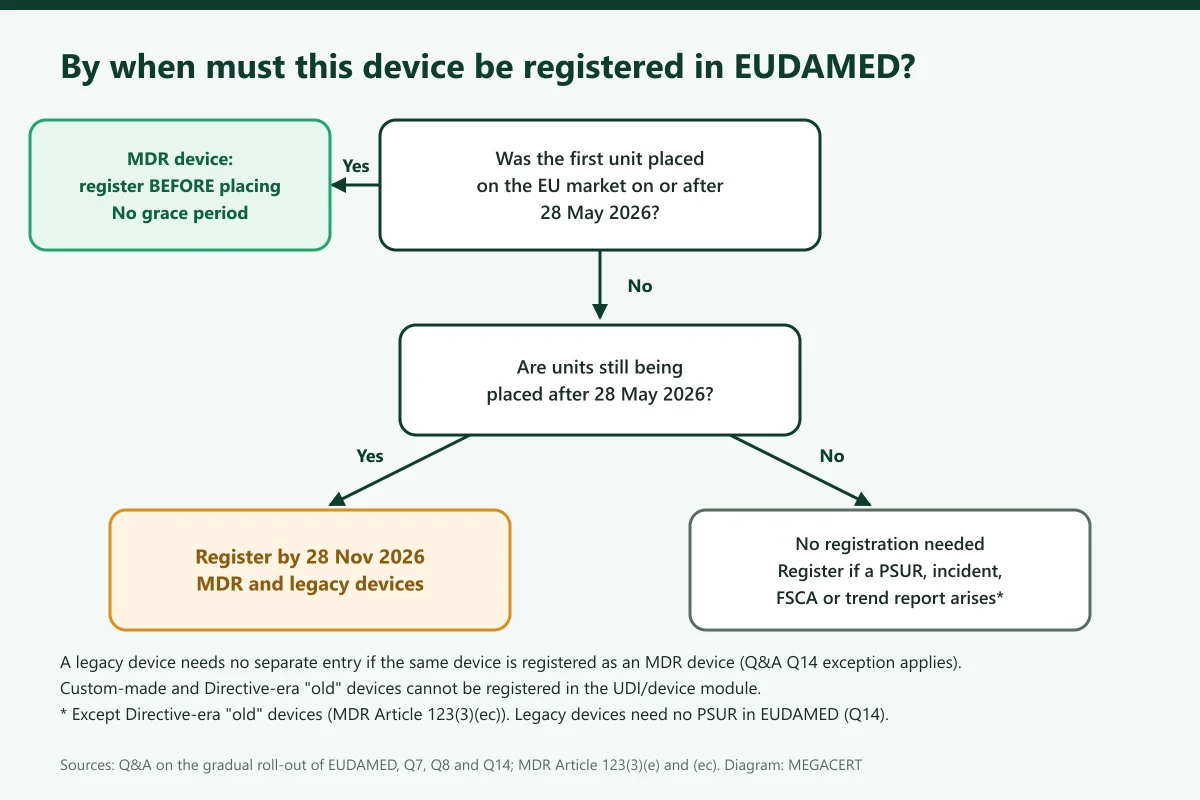
### The four branches of the decision tree
- First unit placed on or after 28 May 2026: the MDR device must be registered in the UDI/device module before its first unit is placed on the market. There is no grace period (Q7; Commission chart for Regulation devices).
- First unit placed before 28 May 2026 and still being placed: both MDR devices and legacy devices must be registered by 28 November 2026.
- No units placed on the market after 28 May 2026: registration is not required. If a periodic safety update report (PSUR), serious incident report, field safety corrective action (FSCA) or trend report is later needed for that device, the device must then be registered (MDR Article 123(3)(ec); Q8). For legacy devices, only a serious incident, FSCA or trend report triggers this, because they do not require a PSUR in EUDAMED (Q14, footnote 16). The exception is an "old" device placed on the market under the Directives, which cannot be registered.
- Legacy device whose MDR equivalent is already registered: the legacy device does not need a separate registration. Under Q8, a Regulation device and a legacy device are "the same device" when they share the same identification, such as the UDI-DI, and/or catalogue or reference number and/or trade name, following from shared characteristics. A change that leads to a new UDI-DI for the Regulation device means it is not the same device. The Q&A sets out an exception in Q14: if a serious incident report, FSCA or trend report concerns the legacy device itself rather than the same Regulation device, the legacy device must exceptionally be registered. Where you are unsure, confirm with your notified body or competent authority before 28 November 2026.
### Custom-made devices, old devices and certificate links
Custom-made devices and "old" devices from the Directive era cannot be registered in the UDI/device module. According to Q8, if one of them becomes the subject of a serious incident report or FSCA, the manufacturer will need to provide a limited device data set in the vigilance module once that module is in use.
For certain devices, the Q&A notes that UDI and device data will become visible to the public only once the notified body has entered the corresponding certificate. The same note says that submitting all required device information meets the manufacturer's Article 29 registration obligation, so the remaining task is to follow up the certificate link with your notified body. Once the certificate is entered, the obligations to upload the summary of safety and clinical performance and to make the Article 55(1) notification also apply where relevant (Article 123(3)(eb)).

Actor registration and the SRN: who, when and how
Every other EUDAMED task starts from an actor registration. MDR Article 31 requires manufacturers, authorised representatives and importers to submit the information in Annex VI, Part A, Section 1 before placing a device on the market. Where a notified body is involved, this must happen before applying to the notified body (MDR consolidated text).
The competent authority verifies the data and then issues a Single Registration Number (SRN). The manufacturer uses the SRN when applying to a notified body and when accessing EUDAMED to register devices (Article 31(2) and (3)). The actor record also includes the name, address and contact details of the Person Responsible for Regulatory Compliance (Annex VI, Part A, 1.4), so your PRRC appointment needs to be settled first.
Registration is not a one-off task. The MDR requires updates within one week of any change, and confirmation that the data is accurate within one year of submission and every second year after that. If confirmation is more than six months late, any Member State may take corrective measures on its territory (Article 31(4) and (5)).
Importers have their own check: within two weeks of placing a device on the market, they verify that the manufacturer or authorised representative has registered and add their own details to the entry (Article 30(3)). Distributors do not register in EUDAMED, although Member States may require national distributor registration (Article 30(2)). For the full split of duties, see our guide to MDR economic operators.
EUDAMED and Türkiye-based actors
Manufacturers based in Türkiye receive SRNs with the prefix "TR-MF". EUDAMED's public actor database classifies Türkiye with the country type "EU_EXTENDED", while countries such as China, the United States and Switzerland appear as "NON_EU". EU_EXTENDED is a database classification label. On its own it does not settle which MDR obligations, such as appointing an EU authorised representative, apply to a Türkiye-based manufacturer.
| Actor type | SRN prefix | Records |
|---|---|---|
| Manufacturer | TR-MF | 1,112 |
| Importer | TR-IM | 641 |
| Authorised representative | TR-AR | 67 |
| System or procedure pack producer | TR-PR | 52 |
Method: \`totalElements\` values returned on 17 October 2026 by separate queries to the public EUDAMED actor endpoint (ec.europa.eu/tools/eudamed/api/eos) with a country code and an actor type. Equivalent manufacturer queries returned 3,713 records for Germany, 2,783 for Italy and 2,526 for the United States. Counts may include inactive records and may change over time.
Amendments to the Turkish Medical Device Regulation and IVD Regulation published in Official Gazette No. 32635 on 17 August 2024 add, among other changes, a duty to notify TİTCK at least six months before an interruption of supply, paralleling the Article 10a duty added by Regulation 2024/1860 (Resmî Gazete, 17 August 2024). On 4 May 2026, the Turkish Medicines and Medical Devices Agency (TİTCK) published announcement 2026/KKB-1 on EUDAMED becoming mandatory and its effect on registration in ÜTS, Türkiye's national product tracking system (TİTCK announcement 2026/KKB-1). If you sell into Türkiye as well as the EU, plan EUDAMED and ÜTS registration together and read the full text attached to that announcement before changing your ÜTS workflow.
What to do before 28 November 2026: a six-step checklist
As of 17 October 2026, 42 days remain. This sequence gets the registration done without crowding it into the final week:
- Build a product inventory. List every UDI-DI you place on the EU market and mark whether its first unit was placed before or after 28 May 2026, and whether supply continues. That table lets you apply the decision tree in Figure 2 product by product.
- Check your actor registration. If you already have an SRN, confirm that addresses, contacts and PRRC details are current. If your data confirmation date is close, confirm it now.
- Finish Basic UDI-DI and UDI-DI assignment. MDR Article 29 requires the Basic UDI-DI to be assigned under the issuing entity's rules and entered in the UDI database with the core data elements in Annex VI, Part B.
- Separate your legacy devices. If the same device is already registered as an MDR device, the legacy version needs no separate entry, subject to the exception in Q&A Q14. Otherwise, legacy devices still being supplied must also be registered by 28 November 2026. For the wider transition dates, see our guide to the MDR transition period.
- Agree the certificate link with your notified body. Certificate data is entered by the notified body. Your device record and its certificate record need to connect for the public data to display correctly.
- Prepare your vigilance processes. When the vigilance module goes live there will be no voluntary trial phase. If an incident report, FSCA or trend report (or, for MDR devices, a PSUR) is needed for a device you left unregistered, that device will need registering too, unless it is an "old" device placed on the market under the Directives. Review your post-market surveillance (PMS) and post-market clinical follow-up (PMCF) processes with this in mind.

Frequently asked questions
Is EUDAMED registration mandatory?
Yes. Actor registration and UDI/device registration have been mandatory since 28 May 2026. The legal basis is Commission Decision 2025/2371 together with MDR Article 123(3)(d), as amended by Regulation 2024/1860, and the parallel IVDR provision in Article 113(3).
Which devices does the 28 November 2026 deadline cover?
It covers devices whose first unit was placed on the EU market before 28 May 2026 and whose supply continued after that date. This includes MDR devices and legacy devices placed on the market under MDR Article 120(3). The Commission's transition chart gives the date as 28 November 2026.
Do distributors have to register in EUDAMED?
No. The MDR does not require distributors to register as actors in EUDAMED. Member States may, however, require national registration of distributors who make devices available on their territory (MDR Article 30(2)).
What is an SRN and who issues it?
The SRN is the Single Registration Number. The economic operator submits its actor registration in EUDAMED; the competent authority then verifies the data and issues the SRN. Manufacturers use it for notified body applications and to register devices.
When will the EUDAMED vigilance module become mandatory?
There is no fixed date yet. The Commission's November 2025 roadmap shows the Official Journal notice for the vigilance module in Q4 2026 and mandatory use in Q2 2027, and says the timeline may change depending on audit results.
Sources
- Commission Decision (EU) 2025/2371, Official Journal, 27.11.2025
- Regulation (EU) 2024/1860, Official Journal, 9.7.2024
- Regulation (EU) 2017/745 (MDR), consolidated text of 10.01.2025
- European Commission, EUDAMED overview
- Q&A on the gradual roll-out of EUDAMED, published on the Commission's website (not formally endorsed)
- European Commission, transition chart for devices placed on the market before mandatory use
- European Commission, six-month transition chart for Regulation devices
- European Commission, certificate registration transition chart
- European Commission, EUDAMED modules roadmap, November 2025
- MDCG 2021-25 Rev. 1, October 2024, application of MDR requirements to legacy and old devices
- EUDAMED public site
- TİTCK announcement 2026/KKB-1, 04.05.2026 (Turkish)
- Resmî Gazete No. 32635, 17.08.2024, amendment to the Turkish Medical Device Regulation (Turkish)
About the author
Ersin Çetin is an MDR / CE Marking Consultant at MEGACERT, advising medical device manufacturers on technical documentation, MDR compliance and EU market entry. That advice draws on a background in food engineering and more than 25 years as a lead auditor, including for ISO 9001, ISO 14001, ISO 22000, ISO 45001, ISO 50001, ISO/IEC 27001 and ISO 14064. Reviewed by Eren İşman, a mechanical engineer and lead auditor with more than 25 years of experience. Eren İşman is a MEGACERT employee, so this is an internal review. Photographs in this article are illustrative and AI-generated. Last updated: 17 October 2026. This article reflects EU and Turkish legislation and European Commission documents in force on 17 October 2026. MEGACERT is a consultancy: it is not a notified body and does not issue CE certificates. For help with EUDAMED actor and device registration, contact us.